


Cannabis Co-Packing Explained: From Bulk Flower to Shelf-Ready Products
Key Takeaways
- Cannabis co-packing is the process of transforming bulk cannabis inputs into packaged, labeled, compliant, retail-ready products.
- Co-packers handle assembly, filling, weighing, compliance labeling, tamper sealing, and retail finishing so brands don’t have to build those capabilities internally.
- Every major product category — flower, pre-rolls, vape carts, and concentrates — can be co-packed at scale.
- California compliance requirements make experienced co-packing partners especially valuable for reducing packaging errors and regulatory risk.
- Co-packing is one of the most efficient ways for cannabis brands to scale production without increasing overhead.
What Is Cannabis Co-Packing?
There’s a gap between a cannabis product in its raw form and that same product sitting on a dispensary shelf.
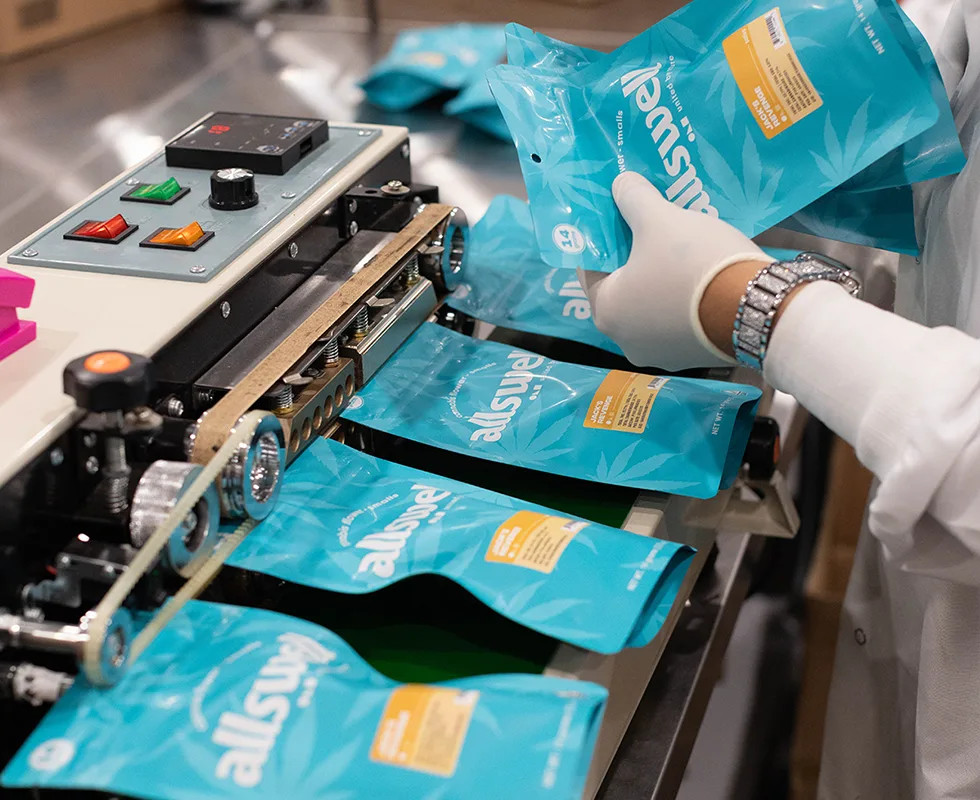
Bulk flower needs to be weighed, inspected, filled into jars or pouches, sealed, labeled, and case-packed. Pre-rolls need to be rolled, filled, assembled into multipacks, and packaged for retail. Vape carts need to be filled with precision, capped, hardware-assembled, and finished. Concentrates need to be filled into containers, sealed, and labeled to California’s compliance standards.
That transformation — from raw input to retail-ready product — is what cannabis co-packing handles.
A cannabis co-packer is a licensed facility that takes bulk or semi-finished cannabis products and turns them into finished, packaged, compliant products ready for distribution and sale.
The brand provides the inputs and the branding direction. The co-packer provides the equipment, labor, compliance workflows, and production expertise to bring the product across the finish line.
Co-Packing vs. Contract Manufacturing vs. White Label
These terms are often used interchangeably in the cannabis industry. Understanding the distinction helps brands identify exactly what they need.
| Term | Who Provides Inputs | What the Partner Handles |
| Co-Packing | Brand provides inputs | Co-packer handles packaging, assembly, and compliance finishing |
| Contract Manufacturing | Manufacturer sources inputs and produces | Brand receives finished product under their label |
| White Label | Manufacturer produces a standard product | Brand applies their own name and packaging |
For many cannabis brands, co-packing is the most common arrangement: the brand controls their supply chain and product inputs while the co-packer handles the labor-intensive packaging and compliance work.
Why Cannabis Brands Use Co-Packers
The cannabis industry is competitive. Retail shelf space is hard to win and harder to keep. Brands that can consistently deliver products on time, at the right quality, with compliant packaging are the ones that build lasting retail relationships.
Co-packing makes that consistency possible without requiring brands to build and operate their own production lines.
Production Without the Overhead
Building an internal packaging operation requires facility space, equipment, production staff, quality control systems, and compliance infrastructure. For most cannabis brands, that investment is difficult to justify — especially early on.
Co-packing removes those fixed costs. Brands pay for production rather than infrastructure.
Speed to Market
Co-packers already have the equipment, workflows, and staff in place. Brands don’t need to hire, train, or build before launching a product.
That speed matters in a market where retail opportunities appear quickly and brands that move fast gain an advantage.
Compliance Confidence
California cannabis packaging compliance is detailed and constantly evolving. Child-resistant requirements, labeling mandates, universal symbol placement, track-and-trace integration — getting it wrong is expensive.
Experienced co-packers have established compliance workflows and stay current with DCC regulatory changes. That expertise reduces the risk of costly errors before products reach distribution.
Scalability
A co-packing partner can scale production volume up or down based on demand. Brands aren’t constrained by the capacity of their own facility or the size of their own team.
That flexibility is especially valuable for brands managing seasonal demand, new product launches, or rapid retail expansion.
Focus on What Drives Growth
Every hour spent managing production is an hour not spent building the brand, winning retail accounts, or developing new products.
Co-packing lets brands stay focused on the activities that drive revenue while a trusted partner handles the operational side of production.
| Co-Packing Advantage | What It Means for Your Brand |
| No Facility Required | Lower overhead and capital requirements |
| Faster Launches | No build-out or hiring before going to market |
| Compliance Expertise | Reduced risk of packaging errors |
| Scalable Volume | Production adjusts to demand without fixed constraints |
| Operational Focus | Brand and sales priorities stay front and center |
| Access to Specialized Equipment | Pre-roll machines, cart fillers, and more without purchasing |
How the Cannabis Co-Packing Process Works
The co-packing process varies by product type, but the general workflow follows a consistent pattern from intake to retail-ready output.
Step 1: Input Intake and Inspection
The brand delivers bulk cannabis inputs to the co-packing facility. This might be bulk flower, extracted oil, concentrate, or pre-filled hardware depending on the product.
The co-packer logs the intake into California’s Metrc track-and-trace system and inspects the inputs against quality and specification benchmarks before production begins.
Step 2: Production and Assembly
This is where the bulk input becomes a finished product.
For flower, this means weighing, filling, and inspecting each unit. For pre-rolls, it means rolling, filling to target weight, and assembling into single packs or multipacks. For vape carts, it means precision filling, capping, and hardware assembly. For concentrates, it means filling into containers and sealing.
Each product category has its own production workflow and quality checkpoints.
Step 3: Compliance Labeling
Every cannabis product sold in California must carry specific compliance information on its packaging.
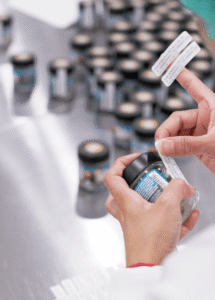
The co-packer applies labels that meet DCC requirements, including:
- Universal cannabis symbol
- Required warnings and disclosures
- Net weight and cannabinoid content
- Batch and lot numbers
- Track-and-trace information
- Child-resistant packaging verification
Experienced co-packers have established label review workflows to catch errors before they reach distribution.
Step 4: Tamper Sealing and Retail Finishing
Once labeled, products are tamper-sealed and prepared for retail presentation. This includes heat shrink bands, sticker seals, or other tamper-evident finishing depending on the product format and packaging spec.
Step 5: Case Packing and Distribution Preparation
Finished units are counted, case-packed, and prepared for pickup by a licensed distributor.
Some co-packing facilities have established distributor relationships and can coordinate distribution logistics directly, simplifying the process for brands.
| Co-Packing Stage | What Happens |
| Input Intake | Logging into Metrc, inspection against spec |
| Production and Assembly | Filling, rolling, weighing, capping per product type |
| Compliance Labeling | DCC-compliant labels applied and verified |
| Tamper Sealing | Retail-ready tamper-evident finishing |
| Case Packing | Unit count, case assembly, distribution prep |
| Want to See the Co-Packing Process in Action?
At Chronic USA®, we walk every prospective partner through our facility so you can see exactly how we take bulk inputs to retail-ready products. |
What Products Can Be Co-Packed?
Most major cannabis product categories are well-suited to co-packing. Here’s what the process looks like across each one.
Flower Co-Packing
Flower co-packing begins with bulk input — typically loose flower delivered by weight.
The co-packer handles:
- Weighing to target unit weight
- Visual inspection and quality screening
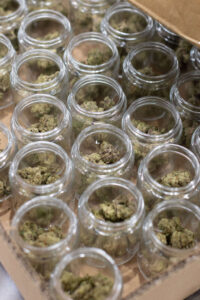
- Filling into jars, pouches, tins, or tubes
- Compliance label application
- Tamper sealing
- Case packing for distribution
Flower co-packing at scale requires precision in weight consistency and quality inspection. Experienced facilities have dedicated workflows and equipment to maintain that consistency across high-volume runs.
Pre-Roll Co-Packing
Pre-roll co-packing is one of the most labor-intensive product categories in cannabis.
Depending on the arrangement, the co-packer can handle:
- Rolling and filling single pre-rolls to target weight
- Infused pre-roll production
- Multipack assembly (2-packs, 5-packs, 10-packs)
- Tip insertion and twist finishing
- Packaging into tubes, boxes, or pouches
- Compliance labeling and tamper sealing
Consistency in fill weight is critical for pre-roll production. Retail buyers and consumers notice inconsistency. Experienced co-packers have systems and equipment designed specifically to maintain fill weight accuracy across large runs.
Vape Cart and Disposable Co-Packing
Vape co-packing requires precision equipment and operator experience with hardware compatibility.
Services typically include:
- Cart filling with distillate, live resin, liquid diamonds, or other oil types
- Capping and hardware assembly
- Leak testing and quality inspection
- Packaging into boxes, blister packs, or retail-ready formats
- Compliance labeling and finishing
Hardware compatibility is a real production variable in vape co-packing. Experienced facilities have worked across a wide range of cart and disposable formats and understand how different hardware performs with different oil viscosities.
Concentrate Co-Packing
Concentrate co-packing covers rosin, live resin, badder, sauce, sugar, and other extract formats.
The process typically includes:
- Filling into glass or silicone containers
- Weight verification per unit
- Lid sealing and tamper finishing
- Compliance label application
- Retail-ready packaging and case packing
Concentrate packaging requires careful handling to maintain product integrity throughout the process. The right co-packer will have temperature-controlled workflows and specialized filling equipment designed for extract consistency.
| Product Category | Typical Co-Packing Services |
| Flower | Weighing, filling, inspection, sealing, labeling, case packing |
| Pre-Rolls | Rolling, filling, multipack assembly, compliance packaging |
| Vape Carts / Disposables | Filling, capping, assembly, inspection, retail finishing |
| Concentrates | Filling, sealing, weight verification, compliance labeling |
California Compliance and Cannabis Co-Packing
California has some of the most detailed cannabis packaging and labeling requirements in the country.
For brands selling into the California market, co-packing compliance isn’t just about avoiding fines. It’s about protecting retail relationships, preventing product recalls, and maintaining the kind of consistent presentation that builds brand trust with consumers.
What California Compliance Requires
Every cannabis product sold in California must meet DCC requirements including:
| Compliance Requirement | Detail |
| Child-Resistant Packaging | Required for all cannabis products sold at retail |
| Universal Cannabis Symbol | Must appear on all retail packaging |
| Required Warnings | Specific language mandated by the DCC |
| Net Weight | Accurate weight declaration per unit |
| Cannabinoid Content | THC and CBD content per unit and per serving |
| Batch and Lot Numbers | Required for track-and-trace compliance |
| Metrc UID Tags | Track-and-trace tags required throughout the supply chain |
| Testing Information | Certificate of analysis reference required |
How Co-Packers Reduce Compliance Risk
A compliance error that reaches distribution can mean products being pulled from shelves, rejected by distributors, or flagged by the DCC.
Experienced cannabis co-packers have established compliance review workflows at every stage of production. Label artwork is reviewed before printing. Labels are verified against batch-specific COA data. Packaging formats are confirmed to meet child-resistance standards before production runs begin.
That level of systematic compliance oversight is difficult to replicate without dedicated internal resources. It’s one of the most meaningful advantages of working with an experienced co-packing partner.
Track-and-Trace Integration
California requires all cannabis products to be tracked through Metrc from cultivation through sale. Co-packers handle Metrc compliance throughout the packaging process, ensuring that every unit leaving the facility is properly tagged, recorded, and ready for distribution.
| Looking for a Co-Packing Partner With Compliance Built In?
Chronic USA® has established compliance workflows for every product category we handle, helping brands avoid costly errors before products reach distribution. |
What to Look for in a Cannabis Co-Packing Partner
Not all co-packing facilities are built the same. Choosing the right partner has a direct impact on product quality, production speed, compliance confidence, and long-term growth.
Valid California Licensing
The co-packing facility must hold a valid California cannabis manufacturing license. Before entering any arrangement, verify that the license is current and in good standing with the DCC.
Multi-Category Production Capabilities
Brands expand. The right co-packing partner should be able to support multiple product categories so you don’t need to find new partners every time you add a SKU.
Look for facilities that can handle flower, pre-rolls, vape products, and concentrates under one roof.
Production Capacity
Make sure the facility can support both your current volume and your anticipated growth. A co-packer that works well at 5,000 units per week may not be the right partner at 50,000.
Ask about capacity constraints and how they handle high-volume orders or rush timelines.
Compliance Track Record
Ask specifically about their compliance workflows — how labels are reviewed, how batches are tracked, and how they stay current with DCC regulatory changes.
A co-packer with a strong compliance track record is one of the most valuable relationships a California cannabis brand can have.
Turnaround Times
Production delays affect retail relationships and revenue. Ask about standard turnaround times for each product category and how they communicate when production schedules shift.
Communication and Transparency
Co-packing is an operational partnership. The facility should be easy to communicate with, transparent about timelines and production status, and proactive when issues arise.
| What to Evaluate | Why It Matters |
| Valid CA Manufacturing License | Non-negotiable — verify before committing |
| Multi-Category Capabilities | Supports growth without changing partners |
| Production Capacity | Can scale with your volume over time |
| Compliance Workflows | Reduces risk of costly labeling errors |
| Turnaround Times | Reliable delivery that supports retail commitments |
| Communication | Transparent and proactive on timelines and issues |
Who Benefits Most From Cannabis Co-Packing?
Co-packing is a valuable model for a wide range of cannabis operators.
New Brands Launching Their First Product
Co-packing removes the biggest barrier to launching a cannabis product: the need to build production infrastructure before generating revenue. New brands can move from concept to retail-ready product without a facility, equipment, or a production team.
Established Brands Scaling Volume
As brands grow, internal production often becomes a bottleneck. Co-packing allows established brands to increase volume without adding staff, leasing more space, or purchasing new equipment.
Dispensaries Launching Private Label Lines
More dispensaries are launching products under their own brand. Co-packing makes this possible without building manufacturing infrastructure. A dispensary can bring flower, pre-rolls, or vapes to market under their own label while a licensed co-packer handles production.
Multi-State Operators Entering California
MSOs entering the California market can partner with an established co-packing facility to launch products quickly without building new infrastructure. This reduces startup costs, compresses time to market, and allows operators to focus on retail distribution rather than production setup.
Brands Launching Seasonal or Limited Products
Not every product needs permanent production infrastructure. Co-packing is ideal for seasonal releases, limited-edition drops, and test SKUs where building dedicated internal capacity wouldn’t make sense.
Co-Packing vs. In-House Packaging: How They Compare
The decision to co-pack or package in-house comes down to resources, scale, and strategic priorities.
| Factor | Co-Packing | In-House Packaging |
| Facility Required | No | Yes — lease, build-out, utilities |
| Equipment Required | No | Yes — significant capital investment |
| Production Staff | Not required | Required — hiring, training, management |
| Compliance Infrastructure | Included with partner | Must be built and maintained internally |
| Time to First Product | Weeks | Months to over a year |
| Fixed Overhead | Low to none | High |
| Scalability | Flexible by volume | Limited by internal capacity |
| Compliance Risk | Managed by experienced partner | Managed internally |
For most cannabis brands — especially those in growth mode or early in their lifecycle — co-packing provides a faster, leaner, and more flexible path to consistent production.
| Ready to Move From Bulk Inputs to Shelf-Ready Products?
Chronic USA® is a licensed cannabis co-packing and manufacturing facility in Long Beach, California. We help brands of all sizes bring products to market with fast turnarounds, consistent quality, and compliance built into every step. Our facility supports: Flower packaging · Pre-roll manufacturing · Cart filling · Concentrate packaging · White label products · Compliance packaging · Distribution support · High-volume production |
Frequently Asked Questions
What is cannabis co-packing?
Cannabis co-packing is the process of transforming bulk or semi-finished cannabis products into packaged, labeled, compliant, retail-ready products. A licensed co-packing facility handles assembly, filling, compliance labeling, tamper sealing, and distribution preparation on behalf of the brand.
Why do cannabis brands use co-packers?
Cannabis brands use co-packers to access production capacity, compliance expertise, and packaging capabilities without building those capabilities internally. Co-packing reduces overhead, speeds up time to market, improves compliance consistency, and allows brands to scale production without adding staff or leasing facility space.
What products can be co-packed?
Most major cannabis product categories can be co-packed, including flower, pre-rolls, vape cartridges, disposables, and concentrates. The specific products available depend on the co-packing facility’s license type and production capabilities.
What is the difference between co-packing and contract manufacturing?
In a co-packing arrangement, the brand typically provides the cannabis inputs and the co-packer handles packaging, labeling, and retail finishing. In contract manufacturing, the manufacturer sources inputs and produces the finished product on behalf of the brand. Many facilities offer both models depending on the brand’s needs.
Is cannabis co-packing legal in California?
Yes. Cannabis co-packing is legal in California when all parties hold the appropriate state licenses. The co-packing facility must hold a valid California cannabis manufacturing license, and the brand must hold the appropriate license for distribution and retail. All products must also meet California DCC packaging, labeling, and testing requirements.
How does California compliance work in co-packing?
Experienced California cannabis co-packers have established workflows for meeting DCC packaging and labeling requirements, including child-resistant packaging, required warnings, cannabinoid content disclosure, batch and lot numbers, and Metrc track-and-trace integration. Compliance is managed throughout the production process before products reach distribution.
How do I choose the right cannabis co-packing partner?
Look for a co-packing partner with a valid California manufacturing license, experience across multiple product categories, production capacity that can support your growth, strong compliance workflows, and reliable turnaround times. Visiting the facility before committing is always recommended.
Can dispensaries use co-packers to launch their own brand?
Yes. Many dispensaries use cannabis co-packing partners to launch private label flower, pre-rolls, vapes, and concentrates under their own branding. Co-packing allows dispensaries to bring products to market without building or operating a manufacturing facility.
What should I bring to a co-packing facility for the first run?
Most co-packers will need your bulk cannabis inputs, packaging materials and artwork, COA documentation from your licensed testing lab, and any specific production specs such as target fill weights or packaging formats. Your co-packing partner should provide a detailed intake checklist before your first production run.
How fast can a co-packer turn around a production run?
Turnaround times vary depending on product type, production volume, and the co-packer’s current schedule. Experienced facilities can often complete standard production runs within one to two weeks of input intake. Rush timelines may be available depending on capacity.