
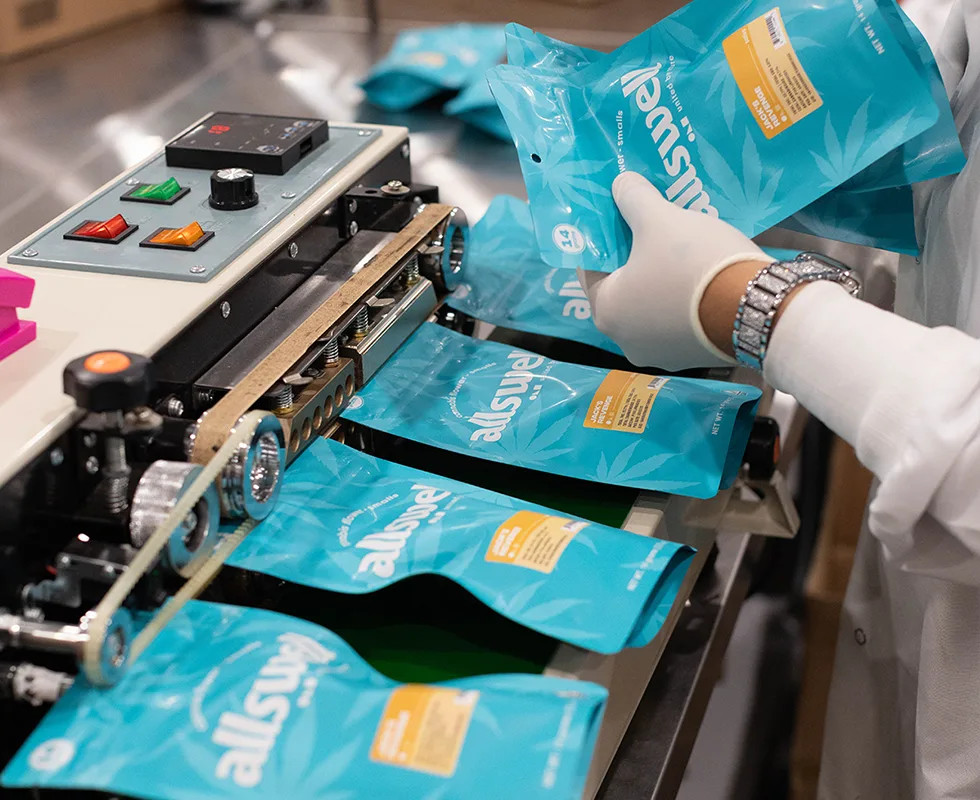


Why Labor Costs Are Crushing Small Cannabis Operators
Why Labor Costs Are Crushing Small Cannabis Operators
Key Takeaways
- Labor is one of the largest and fastest-growing cost categories for cannabis operators with internal manufacturing, often consuming 30% to 50% of total operating expenses.
- California’s minimum wage increases, benefits requirements, and cannabis-specific workforce challenges have made in-house production staff more expensive than most operators planned for.
- Production roles — pre-roll rolling, flower packaging, cart filling, concentrate packaging — are highly labor-intensive and difficult to scale without a corresponding increase in headcount.
- Compliance staffing is a separate and growing cost that many operators underestimate when building their production model.
- Outsourcing production to a licensed cannabis manufacturing partner converts fixed labor costs into variable production costs tied directly to volume — one of the clearest paths to improving unit economics in a compressed-margin environment.
The Labor Problem Operators Did Not See Coming
When California’s legal cannabis market opened, most operators built their financial models around product costs, licensing fees, and facility overhead. Labor was a line item. An important one, but manageable.
In 2026, that view has changed.
Labor has become one of the most significant and most difficult-to-manage cost categories in cannabis operations — especially for operators with internal manufacturing. And unlike rent or equipment, labor costs compound in ways that are hard to predict and harder to reverse once a team is built.
California’s minimum wage has risen substantially. Benefits costs have increased. The complexity of managing a cannabis production workforce — turnover, training, scheduling, compliance oversight — has proven more demanding than operators expected when they were building their business plans.
At the same time, wholesale cannabis prices in California have declined. Margins that once absorbed high labor costs no longer do.
The result is a growing number of cannabis operators — particularly smaller operators with internal manufacturing — who find themselves in a labor cost squeeze that is difficult to escape without fundamentally rethinking how production is structured.
This post breaks down why cannabis labor costs are rising, which roles are hardest to scale, and what operators are doing to address the problem.
Why Cannabis Labor Costs Are Rising in California
The cannabis labor cost problem is not one factor. It is a combination of structural forces that have been building since the legal market opened and are now pressing hardest on operators who built cost models based on earlier assumptions.
California Minimum Wage Increases
California has one of the highest minimum wages in the country, and it has increased substantially over the past several years. For cannabis manufacturing operations that employ a significant number of production workers at or near minimum wage, these increases translate directly into higher payroll costs on every production hour worked.
For an operation running multiple production shifts, even a modest per-hour increase across a team of 10 to 20 production workers adds up to hundreds of thousands of dollars in additional annual labor cost.
Benefits and Employer Costs Beyond Base Wage
Base wage is only part of the true cost of an employee. California employers are responsible for a range of additional costs on top of base pay:
- Payroll taxes — employer-side Social Security, Medicare, and California state payroll taxes
- Workers’ compensation insurance — mandatory for all California employers, with rates that vary by job classification
- State Disability Insurance contributions
- Paid sick leave — California mandates paid sick leave for all employees
- Health insurance contributions — increasingly expected even for production workers in competitive hiring markets
- Overtime — California has daily overtime rules (over 8 hours in a day, not just 40 per week) that affect shift scheduling and costs
When all employer-side costs are fully accounted for, the true cost of a production worker is typically 25% to 40% above their base hourly rate. Many operators build labor models based on base wage alone and are surprised by the true all-in cost.
Cannabis-Specific Workforce Challenges
Cannabis production faces workforce challenges that most industries do not.
The work is physically demanding and repetitive. Pre-roll rolling, flower packaging, and concentrate filling require sustained attention and fine motor consistency across long shifts. This contributes to higher-than-average turnover rates in cannabis production roles.
Background check requirements vary by jurisdiction but can limit the available labor pool in some markets. Some California cities and counties impose restrictions on cannabis employment that add screening complexity.
And despite the growth of the legal industry, cannabis still carries a stigma in some communities that narrows the applicant pool for open production positions.

High Turnover and Its Hidden Costs
Turnover in cannabis production roles is a significant and frequently underestimated cost driver.
Every time a production worker leaves, the operation incurs:
- Recruiting costs — job postings, screening, interviewing
- Onboarding and training time — new workers are slower and less consistent until fully trained
- Productivity loss during the transition — experienced workers often carry more than their official workload, and their departure creates gaps
- Management time — supervisors spend time on hiring and training that could go to production oversight
In high-turnover production environments, these costs repeat continuously rather than being a one-time expense. For some cannabis operations, turnover-related costs represent a meaningful hidden drag on the labor line.
Compliance Staffing as a Separate Cost
Production workers are not the only labor cost in a cannabis manufacturing operation. Compliance staffing is a growing and separate expense that many operators underestimate when building their initial cost models.
California cannabis compliance requires dedicated oversight at the production level:
- Metrc track-and-trace management — entries, transfers, reconciliations
- Label review and compliance verification before production runs
- Quality control oversight — fill weights, visual inspection, batch documentation
- Packaging compliance review — confirming CR certification, tamper seal verification
- Regulatory monitoring — staying current with DCC updates and ensuring production practices reflect current requirements
For smaller operations, compliance responsibilities are often spread across existing staff rather than handled by a dedicated compliance team. This creates a hidden cost: production supervisors and managers spending significant portions of their time on compliance activities rather than production oversight.
| Labor Cost Driver | Impact on Operations |
| Minimum Wage Increases | Direct payroll cost increase on every production hour worked |
| Benefits and Employer Costs | True cost of labor is 25% to 40% above base wage |
| High Turnover | Recurring recruiting, training, and productivity loss costs |
| Cannabis-Specific Challenges | Narrower applicant pool, demanding work conditions, stigma |
| Compliance Staffing | Dedicated or distributed compliance oversight adds to total labor cost |
| Daily Overtime Rules | California’s 8-hour daily overtime threshold increases shift scheduling costs |
Which Cannabis Production Roles Are Hardest to Scale
Not all cannabis production jobs scale the same way. Some roles benefit significantly from automation or process improvement. Others remain stubbornly labor-intensive regardless of volume.
Understanding which roles are difficult to scale helps operators identify where labor costs will grow fastest as production volume increases — and where outsourcing creates the most value.
Pre-Roll Production
Pre-roll manufacturing is one of the most labor-intensive production activities in cannabis. Grinding, filling, finishing, and inspecting pre-rolls at commercial volume requires a significant production team even with automated filling equipment.
Twist finishing in particular remains largely manual. Inspection is manual. And infused pre-roll production — with its coating and rolling steps — requires even more labor per unit than standard pre-rolls.
As brands scale pre-roll volume, labor requirements scale nearly proportionally. There is limited automation available for the finishing and inspection steps that consume the most labor hours per unit.
Flower Packaging
Flower packaging requires human labor for weighing, visual inspection, filling, and quality checking. While semi-automated and automated equipment can assist with filling, the inspection and quality control steps are difficult to fully automate at the quality level the California market expects.
For operations packaging multiple SKUs — different weights, different strains, different formats — changeover between runs adds further labor cost beyond the production time itself.
Concentrate Packaging
Concentrate packaging is slow, precision-dependent work. The products are difficult to handle, packaging is often small-format, and quality inspection requires experienced operators who can recognize consistency issues.
Scaling concentrate packaging output means scaling the team, because automation options for concentrate filling are limited compared to other product categories.
Compliance and Quality Control
Compliance and quality control roles do not scale as efficiently as production roles. A compliance team that can manage 5,000 units per week cannot simply handle 50,000 units with the same headcount — the documentation, verification, and oversight workload scales with volume.
Yet many operators underinvest in compliance staffing at lower volumes and then face a disproportionate hiring need when production scales.
| Production Role | Why It Is Hard to Scale |
| Pre-Roll Production | Twist finishing and inspection remain manual — labor scales nearly proportionally with volume |
| Flower Packaging | Visual inspection and quality checking difficult to fully automate at commercial scale |
| Concentrate Packaging | Precision-dependent, small-format work with limited automation options |
| Infused Pre-Roll Production | More labor per unit than standard pre-rolls due to coating and finishing steps |
| Compliance and QC | Documentation and verification workload scales with volume, not at a discount |
| Want to Stop Scaling Labor and Start Scaling Your Brand?
At Chronic USA®, our production team handles pre-roll manufacturing, flower packaging, cart filling, concentrate packaging, and compliance — so your internal team can focus on growth. |
How Labor Costs Interact With Margin Compression
California cannabis wholesale prices have declined significantly since the early years of the legal market. The products that operators are selling today often generate less revenue per unit than the same products did three or four years ago.
At the same time, labor costs have gone up.
The combination of lower revenue per unit and higher labor cost per unit is the core of the margin compression problem facing small cannabis operators in 2026.
The Fixed Cost Trap
Internal manufacturing operations have a fixed cost floor. Facility lease, equipment, and a minimum staffing level to keep the operation running all continue regardless of how much product is actually being made.
When wholesale prices were higher, that fixed cost floor was easier to absorb. As prices have compressed, the same fixed cost base now represents a larger percentage of revenue — leaving less margin for everything else the business needs.
Volume Is Not the Solution It Appears to Be
The instinctive response to margin compression is to produce more — spread fixed costs across more units and improve per-unit economics.
The problem is that scaling production in a labor-intensive manufacturing operation requires more labor. More labor increases the cost floor. And in a competitive wholesale market, increasing volume does not guarantee proportionally higher revenue.
Many operators who tried to grow their way out of margin compression found that the labor costs required to scale production ate most or all of the margin improvement they were hoping to achieve.
The Math on Outsourcing
When production is outsourced to a licensed manufacturing partner, fixed labor costs are removed from the equation. The brand pays a per-unit or per-run production cost that is variable — tied directly to what is actually produced.
In a compressed-margin environment, converting fixed labor overhead into variable production cost is one of the most effective tools an operator has for improving unit economics without requiring a significant increase in revenue.
| Cost Factor | Internal Manufacturing | Outsourced Production |
| Production Staff Cost | Fixed — continues whether or not production is running | Variable — tied to what is produced |
| Compliance Staff Cost | Fixed — required regardless of volume | Included in manufacturing partner relationship |
| Overhead Absorption | Requires sustained high volume to cover fixed base | No fixed base to cover — cost scales with production |
| Response to Demand Decrease | Fixed costs continue — margin shrinks further | Production cost decreases with volume |
| Response to Demand Increase | Hiring and training lag behind demand | Capacity available through existing partner infrastructure |
Can Outsourcing Cannabis Production Reduce Payroll?
Yes — and for most small cannabis operators with internal manufacturing, it is one of the most significant levers available for reducing operational cost.
What Outsourcing Removes From the Payroll
When production is outsourced to a licensed manufacturing partner, the following labor categories shift from internal headcount to the manufacturing partner’s responsibility:
| Labor Category Removed | What It Covers |
| Production Workers | Rolling, filling, packaging, finishing — the largest labor category in most manufacturing operations |
| Quality Control Staff | Visual inspection, fill weight monitoring, batch record verification |
| Compliance Oversight | Metrc management, label review, packaging compliance verification |
| Production Management | Scheduling, workflow coordination, equipment maintenance oversight |
| HR and Workforce Administration | Recruiting, training, benefits administration, turnover management |
For a small cannabis operator running a production team of 8 to 15 people, outsourcing production can reduce internal headcount by 50% to 80% — a meaningful reduction in fixed payroll, benefits, and the management overhead associated with running a production workforce.
What Internal Teams Look Like After Outsourcing
Brands that outsource production typically reorganize their internal teams around the commercial and strategic functions that drive growth:
- Sales and retail account management
- Brand and marketing
- Product development and innovation
- Supply chain coordination with the manufacturing partner
- Finance and operations
These are the roles that directly generate revenue and brand value. They are also the roles that are most rewarding to build and least subject to the turnover and management challenges that plague production teams.
The Transition Question
For operators who have already built an internal production team, transitioning to outsourced manufacturing is not without complexity. Existing staff need to be redeployed or transitioned out. Production relationships with suppliers need to be transferred. And the manufacturing partner needs to be brought up to speed on product specifications and quality standards.
Most operators who have made this transition report that the short-term complexity of the change is outweighed by the long-term reduction in operational overhead and the freeing of leadership attention for growth activities.
What Operators Are Doing to Address the Labor Cost Problem
Across California’s cannabis industry, operators are responding to the labor cost challenge in several ways. The approaches that are working tend to share a common thread: they reduce the fixed cost floor while maintaining or improving production output.
Outsourcing Manufacturing and Co-Packing
The most direct response to labor cost pressure is outsourcing production entirely to a licensed cannabis manufacturing or co-packing partner. This converts production labor from a fixed overhead cost to a variable production cost, eliminates the management burden of running a production team, and often improves consistency because the manufacturing partner’s workflows are purpose-built for efficiency.
Narrowing the SKU Portfolio
Operators running a wide SKU portfolio face disproportionate labor costs because changeovers between products add setup time without adding production output. Narrowing to a focused SKU portfolio reduces changeover labor, simplifies compliance documentation, and makes production scheduling more efficient.
Focusing Internal Labor on High-Value Activities
Some operators retain internal production for their highest-volume, most profitable SKUs and outsource lower-volume, more labor-intensive products. This concentrates internal labor where it generates the most return and shifts the marginal labor cost to a manufacturing partner for everything else.
Investing in Automation Where It Makes Sense
For operators who choose to maintain internal production, targeted automation investment — in pre-roll filling machines, flower packaging equipment, or label application systems — can reduce per-unit labor cost for specific production steps. The key is targeting automation at the highest-volume, most repetitive steps where the investment pays back quickly against reduced labor hours.
| Approach | Why It Works |
| Outsource Manufacturing | Converts fixed labor overhead to variable production cost — highest impact option |
| Narrow SKU Portfolio | Reduces changeover labor and complexity — improves production efficiency |
| Hybrid Model | Retain internal production for highest-volume SKUs, outsource the rest |
| Targeted Automation | Invest in automation for highest-volume, most repetitive production steps |
| Reorganize Internal Team | Shift internal headcount from production to commercial and growth activities |
| Ready to Convert Fixed Labor Overhead Into Variable Production Cost?
Chronic USA® helps cannabis brands eliminate production labor overhead and scale output without scaling headcount. Pre-rolls, flower packaging, cart filling, concentrate packaging, and white label — all from our licensed Long Beach facility. |
The Bigger Picture
Labor cost pressure is not going away. California’s wage environment will continue to put upward pressure on production payroll. Cannabis-specific workforce challenges will not resolve on their own. And margin compression makes the fixed cost of an internal production team harder to justify every year.
For small cannabis operators, the labor cost problem is ultimately a question about where limited resources create the most value.
A production team that builds brand loyalty is hard to find. But a production team that fills jars and rolls pre-rolls — at an increasing cost per unit, in a declining price environment — is a resource allocation problem with a clearer solution.
The brands navigating the labor cost challenge most effectively are the ones that have stopped trying to compete on production capacity and started competing on brand, product innovation, and retail relationships.
Those are the capabilities that build long-term value in California’s cannabis market. And they are much harder to build when leadership bandwidth is absorbed by managing a production workforce.
| Ready to Stop Managing Production and Start Building Your Brand?
Chronic USA® is a licensed cannabis manufacturing and co-packing facility in Long Beach, California. We help operators reduce production overhead, improve consistency, and free their teams to focus on what actually grows the business. Our facility supports: Pre-roll manufacturing · Flower packaging · Cart filling · Concentrate packaging · White label products · Compliance packaging · High-volume production |
Frequently Asked Questions
Why are cannabis labor costs rising in California?
Cannabis labor costs in California are rising due to a combination of forces: substantial minimum wage increases over the past several years, California’s daily overtime rules that increase shift scheduling costs, mandatory benefits requirements including paid sick leave and workers’ compensation, high turnover rates in cannabis production roles that generate recurring recruiting and training costs, and the growing complexity of compliance staffing requirements. When all employer-side costs are factored in, the true cost of a production worker is typically 25% to 40% above their base hourly wage.
Can outsourcing cannabis production reduce payroll costs?
Yes. Outsourcing production to a licensed cannabis manufacturing partner removes production workers, quality control staff, compliance oversight personnel, and production management from the internal payroll. For most small cannabis operators running internal production teams of 8 to 15 people, outsourcing can reduce internal headcount by 50% to 80% and convert fixed labor overhead into variable production costs tied directly to output volume. In a compressed-margin environment, this shift in cost structure is one of the most effective levers available for improving unit economics.

What cannabis production jobs are hardest to scale?
Pre-roll production is among the most difficult to scale because twist finishing and inspection remain largely manual regardless of volume. Flower packaging requires human visual inspection and quality checking at every stage. Concentrate packaging is precision-dependent work with limited automation options. Infused pre-roll production requires more labor per unit than standard pre-rolls due to coating and finishing steps. Compliance and quality control roles also scale poorly because documentation and verification workload increases proportionally with production volume.
How does labor cost interact with cannabis margin compression?
Margin compression and rising labor costs create a compounding problem for operators with internal manufacturing. Lower wholesale prices reduce revenue per unit. Higher labor costs increase cost per unit. The fixed cost floor of an internal production operation — facility, equipment, minimum staffing — continues regardless of production volume. As margins compress, that fixed base absorbs an increasingly large share of revenue. Scaling production to spread fixed costs often requires proportionally more labor, reducing the expected margin improvement.
What is the true cost of a cannabis production employee in California?
The true cost of a California cannabis production employee includes base hourly wage, employer-side payroll taxes (Social Security, Medicare, state payroll taxes), workers’ compensation insurance, state disability insurance contributions, paid sick leave, health insurance contributions, and the cost of California’s daily overtime rules. When all employer-side costs are accounted for, the total cost is typically 25% to 40% above base hourly wage. Many operators build labor cost models based on base wage alone and are surprised by the all-in number.
Why is cannabis production turnover so high?
Cannabis production work is physically demanding, repetitive, and often performed in controlled indoor environments for extended shifts. These conditions contribute to above-average turnover compared to other industries. Background check requirements in some jurisdictions limit the available labor pool. And despite the growth of the legal industry, some communities still associate cannabis work with stigma that affects retention. High turnover creates a cycle of recurring recruiting, onboarding, and training costs that compound over time.
What is compliance staffing and why does it cost so much?
Compliance staffing refers to the labor required to manage California cannabis regulatory obligations at the production level: Metrc track-and-trace management, label review and compliance verification, quality control documentation, packaging compliance oversight, and regulatory monitoring. For smaller operations, compliance responsibilities are often distributed across existing staff — meaning production supervisors and managers spend significant portions of their time on compliance rather than production. As volume grows, dedicated compliance staff become necessary, adding a fixed cost that scales imperfectly with output.
How do operators reduce cannabis labor costs without reducing output?
The most effective approaches include outsourcing production to a licensed manufacturing partner (converting fixed labor overhead to variable production cost), narrowing the SKU portfolio to reduce changeover labor, focusing internal production on highest-volume SKUs while outsourcing lower-volume products, targeted automation investment for high-volume repetitive steps, and reorganizing internal teams around commercial activities rather than production functions. Operators who combine outsourced manufacturing with a lean internal team focused on sales, brand, and product development consistently report improved unit economics and better resource allocation.
Is it cheaper to outsource cannabis manufacturing or hire more production staff?
For most small and mid-size cannabis operators, outsourcing is significantly more cost-effective than hiring additional production staff — particularly when all-in labor costs, management overhead, turnover costs, and compliance staffing are factored in alongside base wages. The comparison changes at very high sustained production volumes where internal manufacturing can achieve unit economics that are difficult for outsourced arrangements to match. Most California cannabis brands are not yet at that volume threshold, and outsourcing provides better unit economics for the majority of the production scale range.
What does an internal team look like after outsourcing production?
Brands that outsource production typically reorganize their internal teams around commercial and strategic functions: sales and retail account management, brand and marketing, product development and innovation, supply chain coordination with the manufacturing partner, and finance and operations. These roles generate revenue and brand value directly. They are also less subject to the turnover and management challenges that make production teams expensive to run. Most operators who make this transition report that leaner, commercially focused internal teams are more effective and easier to manage than the larger production-heavy teams they replaced.