
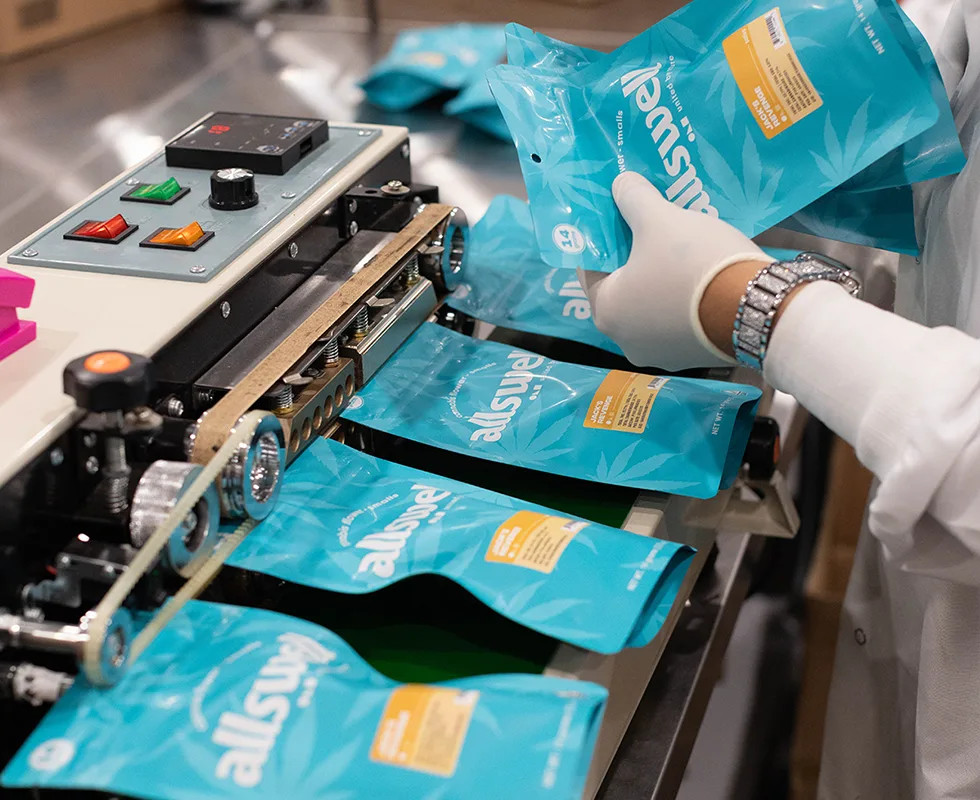


Why More Cannabis Brands Are Outsourcing Production in 2026
Key Takeaways
- The cannabis industry has matured. Operators that once built every capability in-house are now asking where their resources create the most value.
- Margin compression, rising labor costs, and increased compliance complexity are pushing more brands toward outsourced production models.
- Outsourcing manufacturing allows cannabis brands to convert fixed operational overhead into variable production costs tied directly to volume.
- Brands that outsource production consistently report faster time to market, lower operational complexity, and more resources available for growth.
- Cannabis manufacturing outsourcing is not a shortcut. It is a strategic decision that the fastest-growing brands in California are making deliberately.
The Industry Has Changed
In the early years of California’s legal cannabis market, building your own manufacturing operation felt like the only serious path forward.
You controlled quality. You controlled timing. You controlled costs. Ownership over every part of the supply chain felt like a competitive advantage.
In 2026, that thinking has shifted.
The cannabis brands growing fastest today are not the ones trying to own every function. They are the ones who have figured out where they create the most value and built partnerships to handle everything else.
Production is one of those everything elses.
Cannabis manufacturing outsourcing has gone from a workaround for underfunded startups to a deliberate strategic choice made by some of the most sophisticated operators in the California market.
This post explains why that shift is happening and what it means for brands still weighing the decision.
What Changed in the California Cannabis Market
The conditions that made in-house manufacturing appealing in 2018 look very different in 2026.
Margins Have Compressed
Legal cannabis prices in California have declined significantly over the past several years. Wholesale flower prices that once supported wide margins have compressed. Retail competition has intensified. Brands are earning less per unit than they were five years ago.
In that environment, operational efficiency matters more than ever. Every dollar of overhead that is not contributing directly to revenue or brand growth is a dollar working against the business.
Internal manufacturing operations carry significant fixed overhead: facility leases, equipment depreciation, production staff, compliance infrastructure. When margins compress, those fixed costs become harder to absorb.
Labor Has Become More Expensive and More Complex
California labor costs have increased. Minimum wage increases, benefits requirements, and the complexity of managing production staff have made in-house manufacturing meaningfully more expensive than it was at the start of the legal market.
Cannabis manufacturing is also labor-intensive. Pre-roll rolling, flower packaging, cart filling, and concentrate packaging all require skilled, reliable workers who can maintain consistency across high-volume runs.
Recruiting, training, and retaining that workforce is an ongoing operational challenge that many brand operators are not equipped to manage efficiently.
Compliance Has Gotten More Complex
California’s cannabis regulatory framework has continued to evolve. Packaging requirements, labeling mandates, track-and-trace obligations, and testing protocols have all become more detailed and more demanding since the early days of the legal market.
For brands managing production internally, staying current with DCC regulatory changes requires dedicated compliance resources. A packaging error or labeling mistake that reaches distribution is not just a minor inconvenience. It can mean products pulled from shelves, distributor relationships damaged, and regulatory exposure that is expensive to resolve.
Experienced manufacturing partners have compliance workflows built into every step of production. That institutional knowledge is difficult to build internally and increasingly valuable to access through a partner.

The Retail Market Has Matured
California’s dispensary landscape has consolidated. Getting products onto shelves is harder than it was in 2018. Keeping them there requires consistent quality, reliable supply, and competitive pricing.
Brands that are operationally lean and focused on retail relationships, product development, and brand building are better positioned to compete in that environment than brands spending significant leadership bandwidth on managing production.
| Market Shift | Why It Pushes Brands Toward Outsourcing |
| Margin Compression | Fixed production overhead is harder to sustain on lower per-unit revenue |
| Rising Labor Costs | In-house production staff is more expensive and complex to manage |
| Compliance Complexity | DCC regulatory requirements demand dedicated expertise |
| Retail Maturation | Winning shelf space requires brand and sales focus, not operational distraction |
| Capital Efficiency | Brands need to deploy capital toward growth, not infrastructure |
How Outsourcing Improves Operational Efficiency
Operational efficiency in cannabis is not just about cost. It is about removing friction from the activities that drive growth.
Every operational bottleneck is a growth bottleneck.
Fixed Costs Become Variable
One of the most significant operational advantages of outsourcing production is the conversion of fixed costs into variable ones.
An internal manufacturing operation carries costs whether or not production is running. Facility lease, equipment maintenance, production staff salaries — these expenses continue regardless of how much product is actually being made.
With an outsourced manufacturing partner, production costs are tied directly to volume. When production increases, costs scale accordingly. When it slows, costs scale down. That flexibility is especially valuable in a market with seasonal demand patterns or brands managing rapid growth.
Leadership Time Goes Back to Growth
In brands with internal manufacturing, leadership often ends up spending a significant portion of their time managing operational issues rather than driving growth.
Production scheduling conflicts. Equipment downtime. Staffing gaps. Compliance corrections. Packaging supplier delays.
These are real operational challenges that consume attention and energy. When a trusted manufacturing partner absorbs that operational complexity, leadership time is freed for the activities that actually grow the business.
Faster Response to Market Opportunities
The cannabis market moves quickly. Retail opportunities open up. New product categories gain momentum. Limited-edition releases generate consumer interest.
Brands with flexible outsourced production can move faster in response to those opportunities. There is no need to reconfigure internal production lines, hire additional staff, or wait for equipment to arrive before a new SKU can go to market.
Speed is a competitive advantage. Outsourcing production is one of the clearest ways to build it.
Access to Specialized Equipment Without Owning It
High-quality cannabis manufacturing equipment is expensive. Pre-roll machines capable of consistent fill weights at scale, precision cart filling equipment, and automated flower packaging systems all represent significant capital investments.
An outsourced manufacturing partner has already made those investments. Brands gain access to specialized production capabilities without the capital outlay or the ongoing maintenance responsibility.
| Thinking About What Outsourcing Could Do for Your Operation?
At Chronic USA®, we help cannabis brands eliminate production bottlenecks and move faster from inputs to retail-ready products. |
Does Outsourcing Cannabis Production Improve Margins?
The short answer is that it depends on where you are in your growth trajectory. But for most cannabis brands, especially those not yet operating at the volume that justifies internal manufacturing, outsourcing has a clear margin advantage.
The True Cost of In-House Manufacturing
Most operators calculate the cost of in-house production based on direct costs: materials, labor hours, packaging. What they often undercount is everything else.
| Hidden Cost Category | What Gets Underestimated |
| Facility Lease | Monthly fixed cost regardless of production volume |
| Equipment Depreciation | Capital cost spread across the asset’s useful life |
| Equipment Maintenance | Ongoing repairs, calibration, replacement parts |
| Production Staff | Salaries, benefits, payroll taxes, overtime |
| Compliance Staff | Dedicated resources for regulatory oversight |
| Management Overhead | Leadership time spent on operational management |
| Packaging Inventory | Working capital tied up in materials |
| Quality Control | Dedicated inspection and process resources |
When all of these costs are fully accounted for, the per-unit production cost of in-house manufacturing often looks less competitive than operators initially assume.
Outsourcing as a Variable Cost Model
Outsourced production converts most of those fixed costs into a variable cost per unit. Brands pay for production. They do not pay for a facility to sit idle, equipment to depreciate, or staff to be managed between production runs.
At lower and mid-range production volumes, that variable cost model typically produces better unit economics than a fixed in-house operation.
Where In-House Can Win on Margin
At very high production volumes — where a facility and equipment are running at near-full capacity consistently — in-house manufacturing can achieve unit economics that are difficult for outsourced arrangements to match.
For most cannabis brands in California today, reaching that threshold requires a level of sustained volume that takes years to build. Outsourcing is often the more margin-efficient path until that volume is established.
| Cost Factor | In-House Manufacturing | Outsourced Manufacturing |
| Facility Overhead | High fixed monthly cost | None |
| Equipment Capital | High upfront investment | None |
| Labor | Full staffing costs | Included in production cost |
| Compliance Infrastructure | Must build and maintain | Included with partner |
| Cost Flexibility | Fixed regardless of volume | Variable — scales with production |
| Break-Even Volume | Requires sustained high volume | Lower — no fixed base to cover |
Is Outsourcing More Scalable Than In-House Production?
For most cannabis brands, yes. And the reasons go beyond just cost.
Internal Manufacturing Scales in Steps
When a brand with in-house manufacturing needs to increase production, scaling typically requires a capital investment. More equipment. More staff. More space. Sometimes a facility move.
Each of those steps takes time, costs money, and creates operational disruption. The brand cannot simply dial up production when a large retail order comes in. They have to build toward it.
Outsourced Production Scales Continuously
With a manufacturing partner, scaling production is largely a matter of scheduling more runs. The infrastructure is already there. The equipment exists. The staff is in place.
That means brands can respond to a large retail order, a new dispensary account, or a product launch without a capital event. They can scale up quickly and scale back down just as easily if demand shifts.
Multi-Product Scalability
In-house manufacturing operations are typically built around the products a brand makes today. Adding a new product category — moving from flower to pre-rolls, or from pre-rolls to vape carts — often requires new equipment, new staff training, and new compliance workflows.
A full-service cannabis manufacturing partner already supports multiple product categories. Brands can add SKUs, expand into new formats, or test new products without building new internal capabilities each time.
Geographic Scalability
For brands looking to expand distribution across California or enter new markets, partnering with established manufacturing facilities reduces the operational complexity of geographic growth.
Rather than managing production infrastructure across multiple locations, brands can leverage their manufacturing partner’s existing capacity and relationships to support expansion.
| Scalability Dimension | In-House Manufacturing | Outsourced Manufacturing |
| Volume Scaling | Capital investment required for each step up | Schedule more runs — no capital event needed |
| New Product Categories | New equipment and staff training required | Partner already supports multiple categories |
| Geographic Expansion | New infrastructure required in each market | Leverage partner’s existing capacity |
| Demand Flexibility | Fixed capacity — hard to scale down | Variable — scales with actual demand |
Outsourcing and the Staffing Challenge
One of the most underappreciated advantages of outsourcing cannabis production is what it does to the staffing equation.
Cannabis Production Staffing Is Genuinely Difficult
Finding, training, and retaining reliable production staff in California’s cannabis industry is a real operational challenge.
The work is repetitive and physically demanding. Turnover in cannabis production roles is high. Training new workers takes time and affects output quality until workers are fully up to speed. Managing a production team adds a layer of operational complexity that most brand operators did not anticipate when they decided to bring manufacturing in-house.
What Outsourcing Removes From the Equation
When production is outsourced to a manufacturing partner, the staffing challenge shifts entirely to the partner’s side of the relationship.
The brand does not hire production workers. Does not manage schedules, shifts, or overtime. Does not handle workers’ compensation claims or turnover costs. Does not absorb the productivity loss that comes with training new staff.
For operators who have experienced the reality of managing a production workforce, this is often one of the most compelling arguments for outsourcing.
Leaner Internal Teams
Brands that outsource production can operate with significantly smaller internal teams. Instead of production staff, compliance workers, and operations managers, the internal team can be focused almost entirely on the commercial side of the business: sales, brand, marketing, and product development.
Leaner teams mean lower fixed labor costs and a more focused organizational structure.
| Internal Staffing Challenge | What Outsourcing Removes |
| Production Workers | Recruiting, training, managing ongoing turnover |
| Compliance Staff | Regulatory oversight and packaging review |
| Production Management | Scheduling, quality control, operational oversight |
| HR and Payroll Complexity | Benefits, workers’ comp, labor law compliance |
| Ready to Stop Managing Production and Start Scaling Your Brand?
Chronic USA® handles the production complexity so your team can focus on growth. From flower packaging and pre-rolls to cart filling and white label products, we have the capacity and expertise to support your operation. |
Signs It Is Time to Outsource Cannabis Production
Most brands that outsource production do not do it at launch. They arrive at the decision after experiencing the limitations of in-house manufacturing firsthand.
These are the signals that most commonly precede the shift.
| Signal | What It Usually Means |
| Retailers are waiting on inventory | Production capacity is constraining growth |
| Leadership spends more time on operations than sales | Manufacturing has become the business’s primary focus |
| Production delays are pushing back launches | Internal capacity cannot keep up with commercial pipeline |
| Compliance errors are increasing | Processes are stretched beyond reliable management |
| Labor turnover is affecting output quality | Production staff challenges are compounding |
| Cost per unit keeps rising | Fixed overhead is absorbing margin as volume fluctuates |
| New product categories keep getting delayed | Internal operations cannot absorb expansion |
If more than one of these sounds familiar, production has likely become the primary constraint on growth. Outsourcing is worth a serious evaluation.
What to Look for in a Cannabis Manufacturing Partner
Choosing the right manufacturing partner is as important as the decision to outsource itself. The wrong partner creates new problems. The right one removes old ones.
California Licensing and Compliance Experience
The facility must hold a valid California cannabis manufacturing license. Beyond that, ask specifically about their compliance workflows, how they handle DCC regulatory changes, and their track record on packaging accuracy.
Multi-Category Production Capabilities
A manufacturing partner that can support flower packaging, pre-roll production, vape cart filling, concentrate packaging, and white label products gives brands the flexibility to expand without changing partners.
Capacity That Supports Growth
Confirm that the facility can handle your current volume and your anticipated growth. Ask how they manage scheduling during peak demand and how they communicate when production timelines shift.
Transparent Turnaround Times
Reliable turnaround is essential for maintaining retail relationships. Ask about standard timelines for each product category and get specifics on how they handle rush orders or large volume runs.
A Track Record With Growing Brands
Look for a manufacturing partner that has experience supporting brands through growth, not just processing orders. The best partners understand the commercial pressures their clients are managing and build production workflows that support them.
| What to Evaluate | What to Look For |
| Valid CA Manufacturing License | Verify it is current and in good standing with the DCC |
| Multi-Category Capabilities | Supports growth without requiring new partners |
| Production Capacity | Can scale with your volume trajectory |
| Turnaround Times | Reliable delivery that supports retail commitments |
| Compliance Track Record | Established workflows, low error rate |
| Growth Experience | Has supported scaling brands, not just order fulfillment |
| Ready to Outsource Production and Scale Faster?
Chronic USA® is a licensed cannabis manufacturing and co-packing facility in Long Beach, California. We help brands reduce overhead, improve production consistency, and bring products to market faster. Our facility supports: Pre-roll manufacturing · Flower packaging · Cart filling · Concentrate packaging · White label products · Compliance packaging · Distribution support · High-volume production |
Frequently Asked Questions
Why are cannabis brands outsourcing production in 2026?
A combination of margin compression, rising labor costs, increased compliance complexity, and a more competitive retail environment has made outsourced production increasingly attractive. Brands that outsource manufacturing can reduce fixed overhead, move faster to market, and focus leadership resources on the commercial activities that drive growth.
Is cannabis manufacturing outsourcing more scalable than building in-house?
For most brands, yes. In-house manufacturing scales in capital-intensive steps — more equipment, more staff, more space. Outsourced production scales continuously by scheduling additional runs with an existing partner. That flexibility is especially valuable for brands in growth mode or managing variable demand.
Does outsourcing cannabis production improve margins?
It depends on production volume, but for most brands operating below very high sustained volume, outsourcing produces better unit economics. In-house manufacturing carries significant fixed costs that continue regardless of production volume. Outsourcing converts those fixed costs into variable costs tied directly to output.
What is cannabis manufacturing outsourcing?
Cannabis manufacturing outsourcing is the process of partnering with a licensed third-party cannabis manufacturer to handle production, packaging, labeling, compliance, and assembly rather than building those capabilities internally. Brands provide inputs and direction. The manufacturing partner handles execution.
What can be outsourced in cannabis production?
Most major production functions can be outsourced, including flower packaging, pre-roll manufacturing, vape cart filling, concentrate packaging, compliance labeling, white label production, and distribution preparation. The specific capabilities available depend on the manufacturing partner’s license type and facility.
How does outsourcing help with cannabis compliance?
Experienced cannabis manufacturing partners have established compliance workflows for California DCC requirements, including packaging standards, labeling mandates, and Metrc track-and-trace integration. Brands that outsource production to a compliant partner significantly reduce the risk of packaging errors that could result in product recalls or regulatory action.
What are the staffing advantages of outsourcing cannabis production?
Outsourcing production removes the challenge of recruiting, training, and retaining production staff from the brand’s operational responsibilities. It also eliminates the management overhead associated with running a production workforce, freeing the internal team to focus on commercial growth activities.
When should a cannabis brand consider outsourcing production?
Common signals include retailers waiting on inventory, leadership spending more time on operations than sales, production delays pushing back launches, increasing compliance errors, rising per-unit costs, or difficulty adding new product categories. When production has become the primary constraint on growth, outsourcing is worth a serious evaluation.
Can established cannabis brands outsource after building in-house manufacturing?
Yes. Many established brands transition to outsourced production after experiencing the limitations of in-house manufacturing at scale. The transition typically involves winding down internal production operations while shifting volume to a manufacturing partner, often resulting in lower overhead and more flexible production capacity.
How do I find the right cannabis manufacturing partner in California?
Look for a licensed California manufacturer with multi-category production capabilities, capacity that can support your growth, strong compliance workflows, reliable turnaround times, and a track record of working with growing brands. Visiting the facility before committing is always recommended.