

Beginner’s Guide to Launching a Cannabis Product Line in California
Beginner’s Guide to Launching a Cannabis Product Line in California
Key Takeaways
- Launch cannabis product line California with a clear step by step plan covering licensing, manufacturing, packaging, and retail.
- You do not need to own a manufacturing facility to launch a cannabis product. White label and co-packing arrangements allow brands to launch with a licensed manufacturing partner handling production.
- California has specific packaging and labeling requirements that must be met before products can enter the distribution chain — these cannot be treated as an afterthought.
- The fastest path to market for most new brands is outsourced manufacturing combined with a focused retail strategy through a licensed distribution partner.
- Building a strong brand identity and a clear consumer positioning before launch is as important as getting the compliance and operational elements right.
Where to Start When Launching a Cannabis Brand in California
California is one of the most exciting and most demanding markets in the cannabis industry. The consumer base is large, brand-aware, and willing to engage with new products. The retail infrastructure is well-developed. And the market rewards brands that bring something genuine to the table.
It also has a compliance environment, a supply chain structure, and a competitive landscape that can feel overwhelming to operators who are starting from scratch.
This guide is designed for operators who are new to launching a cannabis product line in California. It walks through every major step in plain language — from defining your product and brand through licensing, manufacturing, packaging, testing, distribution, and retail activation.
The goal is to give you a complete map of the process so you can build a realistic plan, avoid the most common mistakes, and move toward your first retail placement with confidence.
Step 1: Define Your Product Line and Brand Positioning
Before anything else — before licensing, before manufacturing, before packaging — you need clarity on what you are building and for whom.
This is the step that most new cannabis operators rush through. It is also the step that most determines whether a brand builds lasting retail relationships or struggles to get traction.
Choose Your Product Category
California’s cannabis market offers a wide range of product categories. As a new brand, choosing where to start matters.
| Product Category | What to Know as a New Brand |
| Flower | High consumer familiarity, competitive market, relatively straightforward production through co-packing |
| Pre-Rolls | One of the fastest-growing categories, strong retail demand, accessible through contract manufacturing |
| Vape Cartridges and Disposables | Premium price positioning available, requires oil sourcing and hardware decisions, strong consumer demand |
| Concentrates | Smaller but loyal consumer segment, premium positioning, requires specialized production |
| Edibles and Infused Products | Wide consumer appeal, complex production and compliance requirements, highly regulated |
Starting with one or two product categories is almost always better than trying to launch across multiple categories simultaneously. Focus allows you to do the compliance, production, and retail work well before expanding.
Define Your Brand Positioning
California’s cannabis retail environment is crowded. There are hundreds of established brands competing for dispensary shelf space. The brands that win placement and consumer loyalty are the ones with a clear, specific positioning — not the ones trying to appeal to everyone.
Before launch, you need clear answers to:
- Who is your target consumer? Be specific — not just “cannabis users” but a defined consumer segment with identifiable characteristics.
- What makes your product different? Quality tier, strain focus, format innovation, brand story, values — what gives a dispensary buyer a reason to choose your product over the alternatives?
- What is your price positioning? California’s market spans from value products to ultra-premium. Your positioning affects everything from production decisions to retail targeting.
- What is the brand story? Consumers in California’s cannabis market respond to authentic brand narratives. What is the story behind your brand that makes it worth caring about?
Build Your Brand Identity
Your brand identity — name, logo, color system, typography, visual language — is what consumers and buyers will see before they ever try your product. In a retail environment where first impressions determine whether a product gets considered, brand identity is not a luxury. It is infrastructure.
Invest in professional brand design before you invest in packaging production. Changing brand identity after packaging is in market is expensive and disruptive.
Step 2: Understand the Licensing Requirements
Cannabis is a licensed industry in California. Every business in the supply chain — cultivators, manufacturers, distributors, retailers — must hold the appropriate state and local licenses. Understanding which licenses apply to your specific business model is foundational before building any other part of your launch plan.
Do You Need a Manufacturing License?
This is the first licensing question most new brand operators face — and the answer is more nuanced than it appears.
If you plan to produce your own products in your own facility, you need a California cannabis manufacturing license (Type 6 for non-volatile solvent manufacturing, Type 7 for volatile solvent manufacturing) plus local permits from the city or county where your facility will operate.
If you plan to use a white label or co-packing arrangement — having a licensed manufacturer produce products under your brand — you do not necessarily need your own manufacturing license. The manufacturing partner’s license covers production.
For most new brands launching in California, the white label or co-packing path is the more practical starting point. It eliminates the facility, equipment, and licensing investment required before the first product can be produced.
Licenses You Will Likely Need
| License Type | When You Need It |
| Cannabis Retail License (if selling through own stores) | Type 10 — required to operate a licensed dispensary |
| Distribution License (if self-distributing) | Type 11 — required to transport products between licensees. Most new brands use third-party distributors and do not need this license initially. |
| Manufacturing License (if producing internally) | Type 6 or Type 7 — required to operate your own manufacturing facility. Not required if using a manufacturing partner. |
| Applicable Business Licenses | Standard city and county business registration separate from cannabis-specific licenses |
State Licensing vs. Local Permitting
California cannabis licensing requires two separate approvals: state licensing from the DCC and local permits from the city or county where your business operates.
Both are required. Neither alone is sufficient. And local permitting is typically the longer and less predictable part of the process.
Not every California city or county allows cannabis businesses. Some jurisdictions have competitive application processes, moratoriums, or outright bans. Research the local permitting environment in your target jurisdiction before building your timeline around it.
Licensing Timelines
State licensing timelines vary but typically run three to six months or more depending on application completeness, DCC workload, and whether any issues require resolution. Local permitting timelines are more variable — anywhere from a few months to well over a year depending on the jurisdiction.
For brands planning to use a white label or co-packing arrangement, the manufacturing partner’s license covers production and the brand can often generate California revenue before completing its own licensing. This is one of the most significant time-to-market advantages of the outsourced production model.
Step 3: Choose Your Manufacturing Approach
One of the most consequential early decisions in building a California cannabis brand is how production will be handled. For most new brands, this decision comes down to two paths: building internal manufacturing or partnering with a licensed manufacturer.
White Label Manufacturing
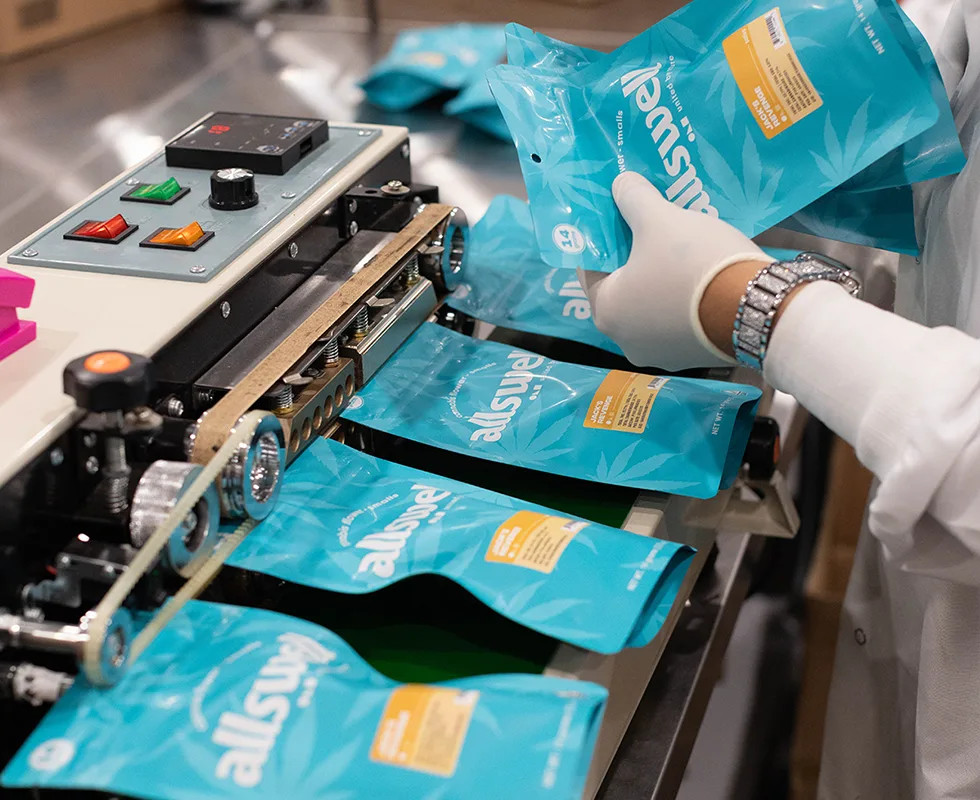
White label manufacturing is when a licensed manufacturer produces cannabis products that are sold under your brand’s name and packaging. You provide the brand identity, packaging specifications, and quality direction. The manufacturer handles production, compliance packaging, and Metrc compliance.
White label is the most accessible production model for new brands. It eliminates the need for facility space, production equipment, production staff, and a manufacturing license before generating revenue.
Co-Packing
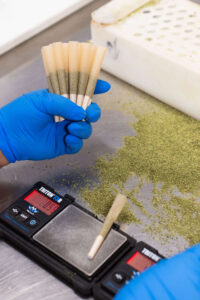
Co-packing is similar to white label but typically involves the brand providing the cannabis inputs — the flower, oil, or concentrate — while the manufacturing partner handles packaging, labeling, and compliance finishing.
Co-packing gives the brand more control over the input materials and supply chain while still outsourcing the labor-intensive packaging and compliance work to an experienced facility.
Building Internal Manufacturing
Building an internal manufacturing operation means leasing a facility, obtaining a California manufacturing license, purchasing production equipment, hiring and training production staff, and building compliance infrastructure — before producing the first unit.
For new brands, this path is expensive, slow, and carries significant risk. The capital required to build internal manufacturing is typically far better deployed toward brand development, retail relationships, and distribution during the early stages of a brand’s growth.
| Factor | White Label | Co-Packing | Internal Manufacturing |
| Who Provides Inputs | Manufacturer sources or brand provides — flexible | Brand provides inputs | Brand sources everything |
| Who Handles Production | Licensed manufacturing partner | Licensed co-packing partner | Internal team |
| License Required | Not required for white label | Not required for co-packing | Type 6 or Type 7 required |
| Capital Required | Low — variable production cost | Low to moderate | High — facility, equipment, staff |
| Time to First Product | Weeks to a few months | Weeks to a few months | 12 to 36+ months |
| Best For | New brands, lean launch, fast time to market | Brands with established input supply chains | High-volume operations with proven demand |
How to Choose a Manufacturing Partner
For brands taking the white label or co-packing path, the manufacturing partner relationship is one of the most important you will build. Key criteria:
- Valid California manufacturing license in good standing with the DCC
- Experience with your product category — not all facilities handle all product types
- Established DCC-compliant labeling and packaging workflows
- California Metrc compliance expertise
- Production capacity that can support your launch volume and growth trajectory
- Reliable turnaround times with clear communication on production schedules
- Willingness to work with new brands and support the launch process
Schedule a facility tour before committing. Seeing the operation firsthand and meeting the team is the most reliable way to evaluate whether a manufacturing partner is the right fit for your brand.
| Ready to See What Manufacturing Partnership Looks Like?
At Chronic USA®, we work with new cannabis brands to move from concept to shelf-ready products. Schedule a tour of our Long Beach facility and see how we help brands launch. |
Step 4: Design Packaging That Is Compliant and Retail-Ready
Packaging is where brand identity and compliance intersect — and where new operators most frequently make mistakes that delay their launch.
California has detailed, specific packaging and labeling requirements. Products that do not meet these requirements cannot legally enter the distribution chain. Getting packaging right before production is critical.
California Packaging Compliance Requirements
Every cannabis product sold in California must be in child-resistant packaging that meets CPSC testing standards, carry a tamper-evident seal, and include labels with all DCC-required elements. Key label requirements include:
- Universal cannabis symbol on both the primary and informational panels — must use the exact DCC-approved symbol at minimum size
- Full government warning statement verbatim — no paraphrasing
- Total THC and CBD per package and per serving in milligrams — from the batch COA
- Net weight in both metric (grams) and US customary (ounces) units
- Batch and lot number
- Manufacturer name and license number
- Distributor name and license number
- Manufactured date
- Facility address
- Metrc UID tracking number
The Compliance Review Step
Before any packaging artwork is sent to print, it must be reviewed against current DCC requirements. This review should be performed by someone with specific knowledge of California cannabis labeling — not just general design review.
The cost of a compliance review before printing is minimal. The cost of discovering a compliance error after packaging has been printed, delivered, and applied to product is significant — reprinting, relabeling, and production delays that push back your launch timeline.
Child-Resistant Packaging
Child-resistant packaging is not just packaging that looks hard to open. California follows CPSC child-resistant testing standards, which require that packaging has passed specific protocols with panels of children and adults.
Before ordering any packaging, confirm with your supplier that the specific packaging you are ordering is CPSC-certified and appropriate for California cannabis products. Get that confirmation in writing.
Packaging That Works at Retail
Beyond compliance, good cannabis packaging needs to work in a retail environment. Consider:
- How will the product be displayed? Hanging, standing, shelf-laid — the packaging format should match the retail display context.
- Is the brand identity clear from three feet away? Buyers and consumers make quick judgments in a retail environment.
- Does the packaging communicate the right quality signals for your price point? Premium packaging at a value price point, or value packaging at a premium price point, both create dissonance.
- Is the label information easy to read? Potency, strain, and product identity should be accessible to the consumer without hunting for it.
Step 5: Plan for Testing
Every cannabis product sold in California must pass state-required laboratory testing before it can enter the distribution chain. Testing is mandatory, per batch, and cannot be skipped or expedited beyond what licensed laboratories can accommodate.
What Testing Covers
- Potency — total THC and CBD content per unit, which populates the label cannabinoid declaration
- Pesticide screening — confirms absence of regulated pesticide residues
- Heavy metals testing — confirms safe levels of lead, cadmium, arsenic, and mercury
- Microbial testing — screens for harmful bacteria, mold, and yeast
- Residual solvents — required for manufactured products to confirm safe solvent levels
- Moisture content — for flower products
- Foreign materials — screens for physical contaminants
How Testing Fits Into Your Production Timeline
Testing timelines vary by laboratory and product type but typically run five to fifteen business days. Rush testing is available at most labs at a premium.
The critical planning point: products cannot move to retail until a passing COA is on file with the distributor. Testing time must be built into your production-to-retail timeline, not treated as a parallel process.
Also important: the cannabinoid content on your product label must match the COA for that specific batch. Never finalize label artwork with cannabinoid content until the COA for that batch is in hand.
Working With a Manufacturing Partner on Testing
Many licensed manufacturing facilities have established relationships with California testing laboratories and can coordinate sample submission and testing logistics as part of the production workflow. This simplifies a process that can be logistically complex for new brands navigating it independently.
Step 6: Establish a Distribution Relationship
California law requires that cannabis products pass through a licensed distributor before reaching a licensed retailer. You cannot deliver products directly to dispensaries without a distribution license. For most new brands, working with a third-party licensed distributor is the practical and efficient choice.
What a Distributor Does for Your Brand
- Conducts quality assurance review of your products before retail release
- Coordinates state-required laboratory testing and manages COA documentation
- Collects and remits California’s 15% cannabis excise tax
- Transports products to licensed retailers using DCC-compliant vehicles and manifests
- Manages Metrc transfers throughout the distribution chain
- In many cases, actively manages retail buyer relationships on your behalf
Choosing the Right Distributor
Distribution is a commercial relationship as much as a logistics one. The right distributor for your brand has:
- Retail account coverage in the dispensaries where you want your products sold — confirm specific accounts, not just general market claims
- Experience with your product category and price point
- Efficient QA and testing workflows that minimize time between production and retail availability
- A fee structure you understand fully — typically 15% to 30% of wholesale value
- Communication standards that give you visibility into inventory status and retail account feedback
The fastest path to retail for most new brands is through a distributor with existing buyer relationships at target accounts. Do not underestimate the value of that existing relationship network when evaluating distribution partners.
| Need a Manufacturing Partner Who Understands the Full Launch Process?
Chronic USA® supports new cannabis brands from first production run through retail-ready packaging and distribution preparation. Talk with our team about what your launch looks like. |
Step 7: Build Your Retail Strategy
Manufacturing gets your product made. Distribution gets it into the supply chain. Getting it onto dispensary shelves requires a retail strategy — and that means winning over dispensary buyers.
How Dispensary Buyers Think
Dispensary buyers are evaluating hundreds of products. They have limited shelf space and significant accountability for what sells. When a buyer looks at your product, they are asking:
- Is this product compliant and will it pass our QA review without issues?
- Is the packaging professional and shelf-appropriate?
- Does the price point work for our customer base?
- Can this brand consistently supply what they commit to?
- Is there a brand story here that will resonate with our consumers?
Building a Buyer Presentation
When you approach a dispensary buyer, come prepared:
- Product line overview with clear SKU descriptions, photography, and pricing
- COA documentation for available batches
- Minimum order quantities and standard lead times
- Distribution partner information — buyers want to know who is servicing the account
- Brand story and marketing materials — social presence, any consumer recognition or press
- Wholesale pricing and suggested retail price for each SKU
Starting Small and Building
For new brands, the goal of the first retail relationship is not to maximize shelf space immediately. It is to prove sell-through, build buyer trust, and create the foundation for broader placement.
A focused launch at five to ten accounts where your product positioning genuinely fits — and where you can consistently supply — is a stronger foundation than scattered placement at thirty accounts where you cannot maintain supply or where the positioning does not land.
Sell-through data from initial accounts is the most powerful sales tool you will have for expanding into new accounts.
After the First Order
Supply reliability is a brand attribute in California cannabis retail. Buyers who place a first order and receive consistent, on-time replenishment at the expected quality level become advocates. Buyers who place a first order and experience supply gaps or quality inconsistency replace the product.
Build your production and distribution workflow to support consistent replenishment from the start — not as an afterthought once you have retail relationships in place.
Step 8: Launch Checklist
Before your first production run, confirm that every item on this list is in place.
Brand and Product
| Item | What Done Looks Like |
| Product category defined | One to two focused categories with clear rationale |
| Consumer positioning defined | Specific target consumer, differentiation, price tier |
| Brand identity completed | Name, logo, color system, visual language finalized |
| Product specifications documented | Fill weights, formats, strain or oil specifications |
Licensing and Compliance
| Item | What Done Looks Like |
| Licensing path confirmed | White label or co-packing path vs. internal manufacturing — decision made |
| Manufacturing partner engaged | Partner selected, facility toured, production terms agreed |
| California DCC requirements reviewed | Current labeling guide downloaded and reviewed |
| Legal and regulatory counsel engaged | California-specific cannabis counsel identified |
Packaging and Labels
| Item | What Done Looks Like |
| Packaging format confirmed | CR-certified packaging sourced and documentation on file |
| Label artwork drafted | All required DCC elements included in draft artwork |
| Compliance review completed | Label artwork reviewed against current DCC requirements |
| Tamper-evident seal specified | Seal format confirmed and included in production spec |
Production and Testing
| Item | What Done Looks Like |
| Manufacturing partner production run scheduled | Timeline confirmed with manufacturing partner |
| Testing laboratory identified | Lab relationship established through partner or directly |
| COA-to-label workflow established | Clear process for updating label cannabinoid content from batch COA |
| Metrc workflow confirmed | Manufacturing partner Metrc process understood |
Distribution and Retail
| Item | What Done Looks Like |
| Distribution partner engaged | Distributor selected with retail account coverage in target markets |
| Initial retail target accounts identified | Five to ten accounts where product positioning fits |
| Buyer presentation prepared | Product overview, pricing, COA, distribution info ready |
| Replenishment schedule planned | Production cadence to support initial retail commitments |
| Ready to Launch Your Cannabis Product Line?
Chronic USA® is a licensed cannabis manufacturing and co-packing facility in Long Beach, California. We work with new brands to move from first production run to retail-ready products with compliance, consistency, and speed built into every step. Our facility supports: Pre-roll manufacturing · Flower packaging · Cart filling · Concentrate packaging · White label products · Compliance packaging · Distribution support · High-volume production |
Frequently Asked Questions
How do I launch a cannabis product line in California?
Launching a cannabis product line in California requires completing several sequential steps: define your product category and brand positioning, understand which licenses apply to your business model, choose your manufacturing approach (white label, co-packing, or internal), design compliant packaging, plan for state-required laboratory testing, establish a distribution relationship with a licensed California distributor, and build a retail strategy for dispensary placement. For most new brands, the fastest path is using a white label or co-packing manufacturing partner rather than building internal production capabilities.
What licenses are needed to launch a cannabis brand in California?
The licenses you need depend on your business model. If you use a white label or co-packing manufacturing partner, you do not need your own manufacturing license — the partner’s license covers production. If you distribute through a licensed third-party distributor, you do not need your own distribution license. Most new brands launching through a manufacturing partner and third-party distributor can begin generating California revenue without their own manufacturing or distribution license, though consulting with California-specific cannabis legal counsel before finalizing your structure is strongly recommended.
Can I use white label manufacturing to launch a cannabis product line?
Yes. White label manufacturing is one of the most accessible and efficient ways to launch a cannabis product line in California. A licensed manufacturing partner produces products under your brand’s name and packaging, handling production, compliance packaging, and Metrc compliance. You provide the brand identity, packaging specifications, and quality direction. This approach eliminates the need for your own facility, production equipment, production staff, and manufacturing license — significantly reducing the capital required to launch and compressing the time from decision to first retail placement.
How long does it take to launch a cannabis product line in California?
Using a white label or co-packing manufacturing partner, most new brands can move from partnership agreement to first retail placements in approximately three to six months. This includes packaging design and compliance review, first production run, laboratory testing (five to fifteen business days), distributor QA review, and initial buyer outreach. Building internal manufacturing infrastructure adds 12 to 36 months or more before the first product can be produced. Licensing timelines vary based on whether the brand needs its own California licenses.
What packaging is required for California cannabis products?
All California cannabis products must be in CPSC-certified child-resistant packaging with a tamper-evident seal. Labels must include the DCC-approved universal cannabis symbol on both panels, full government warning statement, total THC and CBD per package in milligrams, net weight in both metric and US customary units, batch and lot number, manufacturer and distributor license information, manufactured date, facility address, and Metrc UID. Non-compliant packaging cannot enter the distribution chain.
How much does it cost to launch a cannabis brand in California?
Launch costs vary significantly based on approach. Lean brands using white label or co-packing manufacturing, third-party distribution, and a focused SKU count can launch for $50,000 to $150,000 covering licensing and legal costs, packaging design and production, initial manufacturing runs, testing, and early distribution and sales activity. Brands building internal manufacturing infrastructure typically require $500,000 or more before the first product reaches retail. The largest cost lever is the decision between white label or co-packing and building internal production.
What is the difference between white label and co-packing?
In a white label arrangement, the manufacturing partner typically sources or provides cannabis inputs as well as handling production and packaging — the brand provides brand identity and specifications and receives finished products. In a co-packing arrangement, the brand provides the cannabis inputs (flower, oil, concentrate) and the co-packer handles packaging, labeling, compliance finishing, and Metrc compliance. Co-packing gives the brand more control over input sourcing. White label is more turnkey — the manufacturing partner handles more of the supply chain.
Do I need my own testing lab relationship to launch a cannabis product in California?
Not necessarily. Many licensed California manufacturing partners have established relationships with testing laboratories and can coordinate sample submission and COA documentation as part of their production workflow. This simplifies testing logistics for new brands. If your manufacturing partner manages testing logistics, your primary responsibility is ensuring that the cannabinoid content on your label matches the COA for each specific batch — never finalize label artwork with cannabinoid content before the batch COA is in hand.
How do I find dispensaries to carry my new cannabis brand?
The most efficient path to dispensary placement for new brands is through a distribution partner with existing buyer relationships at target retail accounts. Your distributor’s account network gives you access to buyer introductions that would take significantly longer to develop independently. In parallel, attending California cannabis industry events, conducting direct buyer outreach, and preparing a professional buyer presentation with product line overview, pricing, COA documentation, and brand materials all support retail activation. Focus initial placements on accounts where your product positioning genuinely fits and where you can consistently supply.
What are the most common mistakes new cannabis brands make when launching in California?
The most common mistakes include: rushing through brand positioning and launching without a clear differentiated identity; designing packaging without a proper DCC compliance review; finalizing cannabinoid content on labels before the batch COA is received; choosing a manufacturing partner without visiting the facility; underestimating local permitting timelines if building internal manufacturing; building infrastructure before establishing demand; choosing a distributor without confirming specific retail account coverage; and failing to plan replenishment capacity before committing to retail accounts.