


Why Outsourcing Vape Cart Filling Saves Cannabis Brands Money
Why Outsourcing Vape Cart Filling Saves Cannabis Brands Money
Key Takeaways
- Outsource vape cart filling and you convert a stack of fixed equipment, labor, and compliance costs into a single variable per unit fee, and this breakdown shows exactly where those savings come from.
- Outsourcing cart filling converts those fixed costs into variable per-run production fees — improving margin predictability and unit economics across most realistic production scenarios.
- Hardware-oil compatibility is a genuine technical challenge, and experienced filling partners have the cross-format expertise to prevent the costly mismatches that brands without filling experience consistently encounter.
- Cannabis cart filling partners handle the full production workflow: filling, capping, leak inspection, compliance packaging, labeling, and Metrc — removing all of those cost centers from the brand’s internal operation.
- The financial case for outsourcing cart filling is strongest in the first three to five years of a vape brand’s lifecycle, before volume is high enough and consistent enough to justify the capital and operational investment of internal filling capability.
The Cost Structure Behind Cannabis Cart Filling
Vape cartridges and disposable devices are among California’s most popular cannabis product categories. They are also among the most capital-intensive and technically demanding to produce internally.
Brands evaluating whether to build internal filling capability or outsource the function face a decision that looks deceptively simple on the surface — a per-unit cost comparison — but plays out very differently when all costs are properly accounted for.
This post builds that full cost comparison: what internal cart filling actually costs, what outsourcing actually costs, where the savings come from, and which scenario makes outsourcing the financially sound choice for most California cannabis vape brands today.
What Internal Vape Cart Filling Actually Costs
Brands that try to model internal cart filling costs by looking only at direct labor and oil input consistently undercount the true cost of the model. The equipment, facility, technical expertise, and operational overhead that a filling operation requires add substantially to the per-unit cost picture.
Equipment Investment
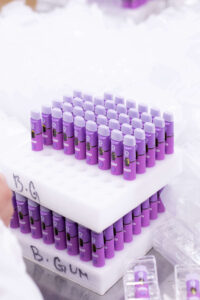
Commercial cart filling equipment is the largest upfront cost of building an internal operation. Equipment investment depends on throughput requirements and oil type:
| Equipment Category | Estimated Cost Range |
| Entry-Level Semi-Automatic Filling Machine | $5,000 to $20,000 — limited throughput, lower precision, suitable for small batch only |
| Mid-Range Automated Filling System | $20,000 to $60,000 — higher throughput, improved precision, suitable for growing operations |
| High-Throughput Commercial Filling System | $60,000 to $150,000+ — high volume, precision dispensing, appropriate for commercial scale |
| Temperature Control Equipment | $2,000 to $15,000 — warming systems, heated reservoirs, inline temperature monitoring |
| Capping Equipment | $1,500 to $20,000 depending on manual, semi-auto, or automated format |
| Calibrated Scales and QC Equipment | $1,000 to $5,000 for fill volume verification and quality control |
| Clean Production Environment Setup | $10,000 to $50,000+ for controlled filling environment appropriate for vape production |
A complete internal cart filling setup — filling machine, temperature control, capping, QC equipment, and a clean production environment — typically requires $50,000 to $300,000 in upfront capital before the first unit is filled.
Ongoing Equipment Costs
Equipment purchase is only the beginning of equipment cost. Ongoing obligations include:
- Annual maintenance and calibration: 5% to 15% of equipment value per year — seals, tips, pumps, and calibration services
- Consumable components: filling tips, gaskets, and seals that wear out with production volume
- Equipment downtime cost: when filling equipment fails, production stops — the cost is both repair and lost production time
- Technology obsolescence: cart filling equipment improves, and operators face periodic decisions about upgrades
Technical Expertise Requirements
Cart filling is not equipment-only — it requires operators with genuine technical expertise in oil handling, hardware compatibility, temperature management, and quality control. This expertise does not come standard.
The costs of building internal expertise include:
- Recruiting and hiring experienced cart filling operators — people with relevant experience in cannabis vape production command premium wages
- Training time — new operators require significant hands-on experience before reaching full production proficiency
- The cost of learning-curve errors — hardware-oil compatibility failures, fill volume drift, and quality control gaps during the learning period
- Staff turnover and ongoing training — production staff turnover is high in California cannabis manufacturing
Facility and Compliance Overhead
- Leased production space with temperature-controlled filling environment
- Metrc compliance infrastructure for vape-specific track-and-trace workflows
- California DCC compliance management for vape product labeling and packaging requirements
- Child-resistant packaging sourcing and CPSC certification management
- Testing laboratory relationships and COA coordination for each production batch
The Complete Internal Filling Cost Picture
| Internal Cost Category | Estimated Monthly Range |
| Equipment (amortized over 3 years) | $1,400 to $8,300+/month depending on equipment investment |
| Equipment Maintenance | $300 to $2,000+/month |
| Production Labor (all-in at California rates) | $4,500 to $12,000+/month for a small filling team |
| Facility Overhead (filling space) | $2,000 to $10,000+/month depending on size and market |
| Compliance Infrastructure | $500 to $2,000+/month for Metrc, label compliance, QC systems |
| Temperature Control Utilities | $300 to $1,500+/month |
| Total Fixed Monthly Overhead | $9,000 to $35,800+/month before a single unit is filled |
Before accounting for oil, hardware, and packaging inputs, many internal cart filling operations carry $10,000 to $35,000 or more in monthly fixed overhead. That floor must be covered by production volume before any margin is generated.
What Outsourcing Vape Cart Filling Actually Costs
The cost structure of outsourced cart filling is radically simpler. Most of the fixed costs that dominate the internal model either disappear entirely or are absorbed by the manufacturing partner.
Production Fee Structure
Outsourced cart filling is typically priced as a per-unit fee or a per-run fee that covers:
- Production labor — filling, capping, settling, and assembly
- Equipment use — the partner’s filling machinery, temperature control systems, and capping equipment
- Equipment maintenance — the partner’s responsibility, not the brand’s
- Quality control — fill volume monitoring, leak inspection, draw testing
- Compliance packaging — child-resistant packaging application
- DCC-compliant label application
- Metrc compliance management — UID tag application and transfer documentation
The per-unit fee is variable. It scales with production volume. When production runs, cost is incurred. When production pauses, cost pauses.
What Remains With the Brand
| Brand’s Remaining Cost | What It Covers |
| Oil and Concentrate Inputs | The brand sources or provides the cannabis oil — distillate, live resin, liquid diamonds, etc. |
| Hardware | The brand selects and procures cartridges or disposable devices — the manufacturing partner fills them |
| Packaging Design and Artwork | The brand provides compliant label artwork — the partner applies it |
| Testing Costs | State-required laboratory testing per batch — typically $300 to $600 per batch at California labs |
| Distribution | Licensed distributor fees — typically 15% to 30% of wholesale value |
| Want to Know What Cart Filling Costs at Chronic USA?
Schedule a tour of our Long Beach facility and talk with our team about your oil type, hardware format, and volume targets. |
The Equipment Costs That Outsourcing Avoids
The equipment avoided through outsourcing is not just the purchase price — it is the full lifecycle cost of owning and operating that equipment in a California cannabis production environment.
Filling Machine Cost Avoided
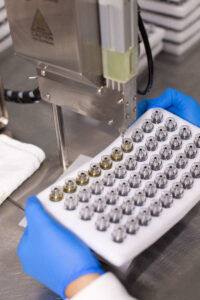
A commercial automated filling machine capable of producing at meaningful volume — typically needed once a brand is past the early-stage test run phase — costs $30,000 to $100,000 or more. At a 3-year amortization, that is $830 to $2,800 per month before maintenance.
An outsourced filling partner has already made this investment. The brand accesses that equipment capacity through the per-unit production fee rather than carrying the capital and amortization cost.
Temperature Control System Cost Avoided
Temperature management is not optional in cart filling — it is fundamental to production quality. Proper temperature control for viscous cannabis oils requires dedicated warming equipment, heated reservoirs, and inline monitoring. A complete temperature control setup runs $5,000 to $15,000 upfront plus ongoing utility costs.
An experienced filling partner has these systems calibrated and operational. The brand does not need to build or maintain them.
The Hardware Compatibility Learning Curve Cost Avoided
Hardware-oil compatibility is one of the most consequential technical challenges in cart filling, and one of the most expensive to learn from scratch. The wrong hardware for a given oil type produces:
- Leaks — oil migration out of the cart during storage or shipping, resulting in returned product and retailer complaints
- Clogs — oil that does not flow correctly to the heating element, resulting in dead carts and consumer dissatisfaction
- Hardware failure — seal materials that degrade with high-terpene oils, producing post-sale failures
- Fill volume inaccuracy — hardware inlet configurations that cause air pockets, underfills, or inconsistent fill volumes
Discovering hardware-oil incompatibility after filling 10,000 units costs far more than the hardware purchase price. An experienced filling partner has worked across dozens of hardware formats and oil types and can provide compatibility guidance before the brand commits to hardware procurement — preventing these failures before they happen.
Equipment Cost Comparison
| Equipment Cost | Internal Filling | Outsourced Filling |
| Commercial Filling Machine | $30,000 to $150,000 upfront | None — included in production fee |
| Temperature Control Systems | $5,000 to $15,000 upfront | None — included in production fee |
| Capping Equipment | $1,500 to $20,000 upfront | None — included in production fee |
| QC Scales and Equipment | $1,000 to $5,000 upfront | None — included in production fee |
| Clean Production Environment | $10,000 to $50,000+ build-out | None — partner’s facility |
| Annual Maintenance | 5% to 15% of equipment value | Partner’s responsibility |
| Equipment Downtime Risk | Brand absorbs lost production and repair costs | Partner’s operational risk |
| Hardware Compatibility R&D | Trial and error at brand’s cost | Partner’s expertise — guidance before commitment |
Labor Savings From Outsourcing Cart Filling
Labor is the largest recurring cost in an internal cart filling operation — and the most complex to manage. Outsourcing shifts the entire labor responsibility to the manufacturing partner.
The True Cost of Internal Cart Filling Labor
A functional cart filling operation requires more than a machine operator. At minimum, an internal vape filling team needs:
- Primary filling machine operator — experienced with oil temperature management, fill volume monitoring, and equipment calibration
- Capping and assembly staff — for post-fill capping, leak inspection, and quality control
- Compliance staff involvement — Metrc entries, label review, packaging compliance verification
At California all-in labor rates (30% to 45% above base wage for employer taxes, workers’ comp, and benefits), a small filling team of two to three operators costs $8,000 to $18,000 or more per month — regardless of how many production runs actually happen.
Labor Cost Per Unit: Internal vs. Outsourced
The per-unit labor cost comparison depends heavily on production volume — the fixed labor cost of an internal team spreads across fewer units at lower volumes, producing high per-unit labor cost that decreases as volume grows.
| Monthly Volume | Internal Labor Cost Per Unit (est.) | Outsourced Labor Cost Per Unit (est.) |
| 500 units/month | $16 to $36 per unit (team cost allocated to low volume) | $0.30 to $0.60 per unit |
| 2,000 units/month | $4.00 to $9.00 per unit | $0.30 to $0.60 per unit |
| 5,000 units/month | $1.60 to $3.60 per unit | $0.30 to $0.60 per unit |
| 10,000 units/month | $0.80 to $1.80 per unit | $0.25 to $0.55 per unit |
| 20,000 units/month | $0.40 to $0.90 per unit | $0.20 to $0.45 per unit (volume pricing) |
The crossover point — where internal labor cost per unit drops below outsourced per-unit fees — occurs at high sustained monthly volumes that most California vape brands have not yet established. Until that volume is proven and consistent, outsourcing produces better per-unit labor economics.
The Management Time Saved
Beyond direct labor cost, internal cart filling consumes management and leadership time that has real opportunity cost:
- Production scheduling and run planning
- Oil temperature and viscosity troubleshooting
- Hardware compatibility evaluation and validation runs
- Quality issue resolution when fill volumes drift or leaks appear
- Equipment maintenance coordination and downtime management
- Compliance oversight for vape-specific DCC requirements
This management bandwidth, redirected to brand building, retail account development, and product innovation, generates compounding commercial value. Outsourcing cart filling is not just a cost reduction — it is a reallocation of leadership attention toward higher-value activities.
Can Manufacturing Partners Handle Packaging Too?
Yes — and this is one of the most underappreciated advantages of outsourcing cart filling to a licensed manufacturing partner.
A full-service California cannabis manufacturing facility handles the complete production workflow from oil intake to distribution-ready product:
What a Complete Cart Filling and Packaging Service Includes
| Service | What It Covers |
| Oil Intake and Temperature Preparation | Oil received, weight verified, warmed to correct filling temperature for specific oil type |
| Hardware Inspection | Cartridges or disposables inspected for defects before filling begins |
| Precision Filling | Automated dispensing to target fill volume with weight-based QC monitoring throughout run |
| Settling and Capping | Filled units allowed to settle, capped with consistent pressure |
| Leak Inspection | Visual inspection and draw testing on sample units from each batch |
| California DCC-Compliant Labeling | Brand’s compliant label artwork applied to retail packaging with oil type disclosure and all required elements |
| Child-Resistant Packaging | CPSC-certified CR packaging applied — documentation on file |
| Tamper-Evident Sealing | Tamper seal applied to all retail units |
| Metrc Compliance | UID tag application, batch entry, transfer documentation |
| Case Packing | Finished units counted, case-packed, prepared for distributor pickup |
A brand working with a full-service manufacturing partner for cart filling does not need to manage packaging procurement logistics, label application equipment, CR packaging certification, or Metrc vape workflows internally. All of those cost centers and operational responsibilities are absorbed into the manufacturing relationship.
Is Outsourcing Cart Filling Cheaper? The Full Comparison
At most production volumes accessible to California cannabis vape brands today, outsourcing produces better total unit economics than internal filling when all costs are properly accounted for.
| Cost Factor | Internal Filling | Outsourced Filling |
| Equipment Capital | $50,000 to $300,000+ upfront | None |
| Equipment Maintenance | 5% to 15% of value annually | Partner’s cost |
| Monthly Fixed Labor | $8,000 to $18,000+ regardless of volume | Variable — per-run only |
| Facility Overhead | $2,000 to $10,000+/month | None |
| Hardware Compatibility Risk | Brand bears cost of compatibility failures | Partner provides guidance before commitment |
| Downtime Risk | Brand absorbs lost production during equipment failure | Partner’s operational risk |
| Compliance Packaging | Separate procurement and application overhead | Included in production service |
| Metrc Management | Internal staff required | Included in production service |
| California DCC Compliance | Must be managed and maintained internally | Partner’s established workflows |
| Time to First Production | 3 to 12+ months (setup, licensing, hiring) | Weeks |
| Break-Even Volume | High sustained volume required to cover fixed base | Variable cost — no fixed base to cover |
The financial advantage of outsourcing is most pronounced at lower to mid production volumes, during periods of demand variability, and in the early years of a vape brand’s development before sustained high volume is established. As volume grows and stabilizes, the economics of internal filling improve — but most California cannabis vape brands are not yet at the threshold where that calculation favors building internal capability.
| Ready to Outsource Cart Filling and Focus on Growing Your Brand?
Chronic USA® provides cannabis cart filling services for distillate, live resin, liquid diamonds, and other oil types out of our licensed Long Beach facility — filling, capping, compliance packaging, and Metrc all handled. |
When Does Internal Cart Filling Make Financial Sense?
Outsourcing is not the right answer for every vape brand at every stage. The calculation shifts as volume grows.
The Volume Threshold
Internal filling begins to make financial sense when sustained monthly production volume is high enough that the fixed cost base is fully absorbed and per-unit economics improve below what outsourcing can offer.
Based on typical California equipment and labor costs, that threshold generally sits at sustained monthly volumes well above where most early-stage and mid-size California vape brands currently operate. Reaching that threshold requires first establishing the brand, distribution relationships, and retail velocity that justify the investment — which typically means starting with outsourced production.
When the Oil Requires Proprietary Equipment
Some specialized oil formats — particularly exotic or proprietary formulations with unusual viscosity characteristics — may require specialized filling equipment that is not available through most co-packing partners. In these cases, internal filling capability may be necessary to maintain the product’s unique characteristics.
This is a narrow exception. Most California vape oil formats — distillate, live resin, liquid diamonds, rosin — are well-supported by experienced filling partners.
The Build-vs-Outsource Decision Framework
| Brand Situation | Recommended Approach |
| Volume is low to mid or variable | Outsource — variable cost structure improves margin predictability |
| Volume is high and consistently sustained | Evaluate internal — fixed costs may be fully absorbed at scale |
| Oil format is standard (distillate, live resin, liquid diamonds) | Outsource — experienced partners handle all common formats |
| Oil format is highly proprietary or unusual | May require internal capability — evaluate partner options first |
| Brand is in first three to five years of building | Outsource — preserve capital and leadership attention for brand growth |
| Brand has established retail velocity and proven demand | Re-evaluate — volume threshold analysis warranted |
| Ready to See What Outsourced Cart Filling Looks Like for Your Brand?
Chronic USA® is a licensed cannabis manufacturing and co-packing facility in Long Beach, California. We handle cart filling for distillate, live resin, liquid diamonds, and other oil types with hardware compatibility guidance, full compliance packaging, and Metrc management built into every production run. Our facility also supports: Pre-roll manufacturing · Flower packaging · Concentrate packaging · White label products · Co-packing · High-volume production |
Frequently Asked Questions
Is outsourcing vape cart filling cheaper than building internal capability?
For most California cannabis vape brands, yes. Internal cart filling requires $50,000 to $300,000 or more in equipment capital before the first unit is produced, plus $10,000 to $35,000 or more in monthly fixed overhead for labor, facility, maintenance, and compliance infrastructure. Outsourcing converts all of those fixed costs into variable per-run production fees that scale with actual output. Per-unit labor economics favor outsourcing at all production volumes below the threshold where internal fixed costs are fully absorbed — a threshold most California vape brands have not yet reached.
What equipment costs does outsourcing vape cart filling avoid?
Outsourcing cart filling eliminates the need to purchase a commercial filling machine ($30,000 to $150,000+), temperature control systems ($5,000 to $15,000), capping equipment ($1,500 to $20,000), QC scales and equipment ($1,000 to $5,000), and build out a clean production environment ($10,000 to $50,000+). It also eliminates ongoing maintenance costs (5% to 15% of equipment value annually), equipment downtime risk, and the hardware compatibility learning curve costs that brands without filling experience consistently encounter when building internal capability.
Can a cannabis manufacturing partner handle packaging as well as filling?
Yes. Full-service California cannabis manufacturing partners handle the complete production workflow from oil intake to distribution-ready product: filling, settling, capping, leak inspection, DCC-compliant label application, child-resistant packaging, tamper-evident sealing, Metrc compliance management, and case packing for distributor pickup. Brands that work with a full-service manufacturing partner for cart filling do not need to manage any of those production cost centers internally — the entire workflow is handled through the manufacturing relationship.
What oil types can be filled by outsourced cart filling partners?
Experienced California cannabis cart filling partners handle all major oil formats: distillate (the most common, requiring higher fill temperatures), live resin (lower viscosity, temperature-sensitive terpene profile), liquid diamonds (THCA diamonds in terpene-rich sauce, requiring hardware with wider inlets), live rosin (solventless, temperature-sensitive), and other full spectrum or specialty oil formats. Oil type affects hardware compatibility requirements, filling temperature, and equipment settings — all of which an experienced filling partner manages as part of their standard production workflow.
What is hardware compatibility and why is it expensive to learn internally?
Hardware compatibility refers to whether a specific cartridge or disposable device performs correctly with a given oil type. Incompatibilities produce leaks, clogs, hardware seal degradation, and fill volume inaccuracy — all of which damage the consumer experience and brand reputation. Discovering a hardware-oil incompatibility after filling large quantities is far more expensive than the hardware cost alone: filled product may need to be discarded, customer complaints must be managed, and retail relationships can be damaged. An experienced filling partner has worked across dozens of hardware formats and oil types and provides compatibility guidance before brands commit to hardware procurement — preventing these failures before they occur.
How does outsourcing cart filling affect California compliance?
Outsourcing cart filling to a licensed California manufacturing partner significantly simplifies compliance management for the brand. The partner manages vape-specific DCC compliance requirements including oil type disclosure on labels, cannabinoid content in milligrams per cartridge verified against the COA, child-resistant packaging with CPSC certification, tamper-evident sealing, and California Metrc track-and-trace compliance throughout the filling and packaging process. The brand’s compliance responsibility is limited to providing compliant label artwork and accurate product specifications.
How does production volume affect the outsource vs. internal filling decision?
Volume is the primary variable in the outsource-vs-internal decision for cart filling. At lower volumes, internal filling produces high per-unit labor costs because fixed team costs are allocated across fewer units — internal labor cost per unit can run $4 to $36 at volumes below 2,000 units per month versus $0.30 to $0.60 for outsourced production. As volume grows, internal per-unit labor cost drops. The crossover point where internal and outsourced per-unit economics become comparable typically requires sustained monthly volumes well above where most early-stage and mid-size California vape brands currently operate.
Does outsourcing cart filling affect product quality?
An experienced California cannabis filling partner typically delivers more consistent fill volumes and better quality control than most brands can achieve early in their internal filling operations. Calibrated commercial filling machines, established temperature control protocols, regular fill volume sampling, and experienced operators who have worked across many oil types and hardware formats all contribute to production consistency. Brands that set clear product specifications, provide consistent oil inputs, and maintain active communication with their filling partner consistently report that outsourced production improves fill consistency compared to early-stage internal filling.
What should I look for when choosing a cannabis cart filling partner?
Key criteria for evaluating a California cannabis cart filling partner include a valid California manufacturing license in good standing, demonstrated experience across the oil types you produce, hardware compatibility guidance capabilities, established temperature control systems, fill volume monitoring with documented QC records, California DCC compliance workflows for vape labeling and packaging, Metrc compliance expertise, reliable turnaround times, and positive references from current vape brand clients at comparable volume. Schedule a facility tour before committing to any cart filling partnership.
