
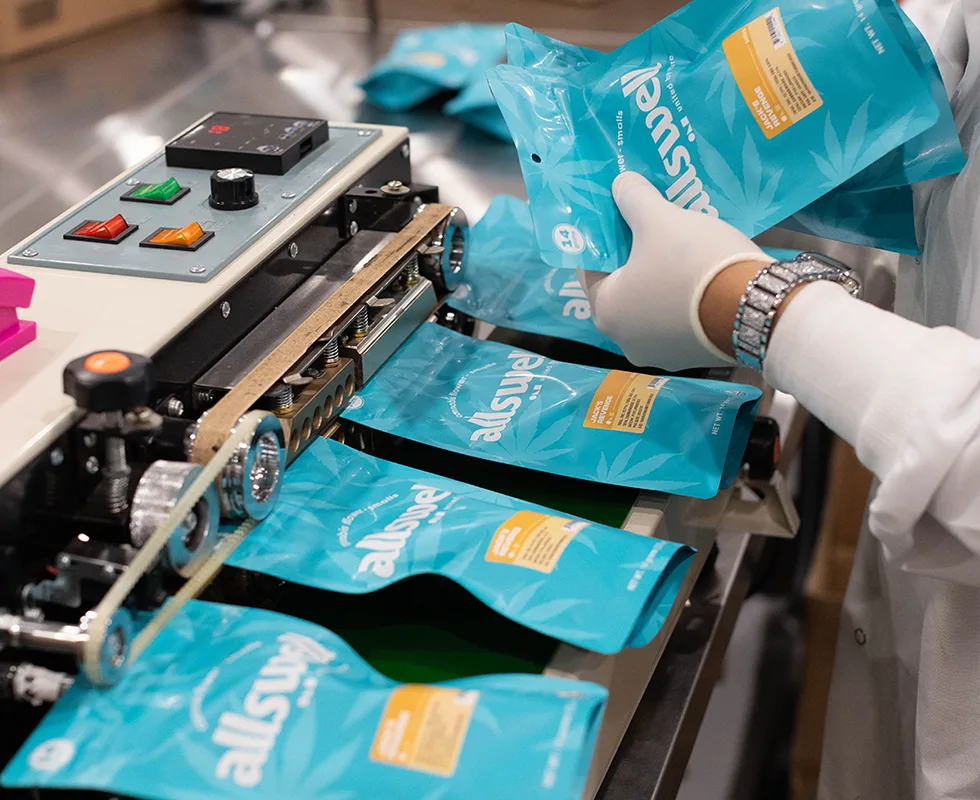


White Label Cannabis Manufacturing for Dispensary House Brands
White Label Cannabis Manufacturing for Dispensary House Brands
Key Takeaways
- Dispensary private label cannabis programs are one of the most effective ways for California retailers to improve margins and build customer loyalty without building a manufacturing operation.
- Dispensaries that own their brand capture margin at both the wholesale and retail levels, versus third-party brands where the dispensary earns only the retail margin on a product sourced at wholesale.
- White label manufacturing allows dispensaries to launch flower, pre-rolls, vape carts, and concentrates under their own brand within weeks — not months — through a licensed manufacturing partner.
- Private label products build customer loyalty in a way third-party products cannot — customers returning specifically for the dispensary’s brand are returning for the store, not just the product.
- The most common barriers to dispensary private label — perceived complexity, upfront cost, compliance knowledge — are significantly reduced when working with an experienced white label manufacturing partner.
Why More Dispensaries Are Launching Their Own Brands
Walk into a grocery store in any major city and a significant portion of what you see on the shelves is the store’s own brand. The products are made by a manufacturer, packaged under the store’s label, and sold at a margin that the retailer controls from end to end.
Cannabis retail is following the same trajectory.
California dispensaries that have launched private label programs consistently report that house brand products generate better margins than third-party products, build stronger customer loyalty, and give the store a point of differentiation that competing dispensaries cannot copy.
The barrier to entry is lower than most dispensary operators assume. White label manufacturing allows a dispensary to launch products under its own brand without a manufacturing license, without production staff, without equipment investment, and without a facility build-out.
This post explains how the model works, what the margin opportunity actually looks like, and what dispensaries need to evaluate when choosing a white label manufacturing partner.
The Margin Case for Dispensary Private Label
The financial argument for dispensary private label starts with a simple observation about where margin lives in the California cannabis supply chain.
Third-Party Brand vs. House Brand: Where Margin Goes
When a dispensary sells a third-party brand, the margin structure looks roughly like this:
| Supply Chain Stage | Who Captures It |
| Manufacturer’s Production Cost | Flower, packaging, labor, testing, compliance |
| Manufacturer’s Margin | Captured by the manufacturer |
| Distribution Fee (15% to 30% of wholesale) | Captured by the distributor |
| California Excise Tax (15% of avg market price) | Passes through to the state |
| Wholesale Price Paid by Dispensary | The dispensary’s cost basis |
| Retail Price | The price the consumer pays |
| Dispensary Margin | Retail price minus wholesale cost — typically 30% to 50% of retail |
When a dispensary sells its own private label product, the structure changes:
| Supply Chain Stage | Who Captures It |
| White Label Manufacturing Cost | Production, packaging, compliance — paid to the manufacturing partner |
| Distribution Fee | Still applies — products still move through a licensed distributor |
| California Excise Tax | Still applies |
| Dispensary’s Cost Basis | Manufacturing cost plus distribution — lower than third-party wholesale |
| Retail Price | The same price the consumer pays |
| Dispensary Margin | Retail price minus the lower cost basis — captures the margin the manufacturer previously held |
The Margin Improvement in Practice
The margin improvement from private label versus third-party products depends on the specific product category and the dispensary’s white label production costs. But the general principle is consistent: by eliminating the manufacturer’s margin and accessing production at cost rather than at wholesale, the dispensary captures significantly more per unit sold.
| Product Category | Third-Party Brand Margin (est.) | Private Label Margin (est.) |
| Pre-Roll (1g) | Retail: $10 / Wholesale cost: $5.50 / Dispensary margin: $4.50 (45%) | Retail: $10 / Production cost: $3.50 / Dispensary margin: $6.50 (65%) |
| Flower (3.5g) | Retail: $30 / Wholesale cost: $18 / Dispensary margin: $12 (40%) | Retail: $30 / Production cost: $12 / Dispensary margin: $18 (60%) |
| Vape Cart (1g) | Retail: $45 / Wholesale cost: $25 / Dispensary margin: $20 (44%) | Retail: $45 / Production cost: $18 / Dispensary margin: $27 (60%) |
| Infused Pre-Roll (1g) | Retail: $18 / Wholesale cost: $10 / Dispensary margin: $8 (44%) | Retail: $18 / Production cost: $7 / Dispensary margin: $11 (61%) |
These are illustrative estimates using common California market price points. Actual margins vary based on production costs, flower quality tier, distribution agreements, and retail pricing strategy. But the directional case is consistent: private label products capture 15 to 20 additional margin percentage points per unit compared to equivalent third-party products.
The Compounding Effect at Scale
A dispensary selling 500 private label pre-rolls per month at $2 additional margin per unit versus a third-party equivalent generates $1,000 in additional monthly gross margin from that product category alone — $12,000 per year.
Across a full private label program — flower, pre-rolls, and vape carts — the incremental annual margin available to a well-run dispensary private label program is meaningful enough to justify the investment in building it.
| Want to Understand What Private Label Could Generate for Your Dispensary?
At Chronic USA®, we work with dispensaries to build private label programs that improve margins and build consumer loyalty. Schedule a tour and let’s talk through your product mix. |
How White Label Manufacturing Works for Dispensaries
White label manufacturing for dispensary private label works the same way it does for standalone cannabis brands — with one difference in context. The dispensary is both the brand and the primary retail outlet for the product.
That integration creates a competitive advantage that standalone brands do not have: the dispensary controls the entire consumer journey from brand creation through the moment of sale.
The White Label Arrangement
In a white label arrangement with a licensed California manufacturing partner:
- The dispensary provides brand identity — name, logo, packaging design, and product positioning
- The manufacturing partner handles production, compliance packaging, and Metrc compliance
- The finished product carries the dispensary’s brand and is delivered distribution-ready
- The product moves through a licensed distributor to the dispensary’s retail location
- The dispensary sells the product on its own shelves under its own brand identity
The dispensary does not need a manufacturing license to have products produced under its brand through a white label arrangement. The manufacturing partner’s license covers production.
What Products Can Be Private Labeled
| Product Category | Private Label Opportunity |
| Flower | Bulk flower packaged into retail-ready units under the dispensary’s brand — the most accessible entry point for most dispensary private label programs |
| Pre-Rolls | Single pre-rolls and multipacks manufactured and packaged under the dispensary’s label — high consumer demand, strong margin profile |
| Infused Pre-Rolls | Premium pre-roll formats with live resin, kief, or liquid diamonds — higher production cost but strong premium positioning |
| Vape Cartridges | Distillate, live resin, or liquid diamonds filled and packaged under the dispensary’s brand |
| Disposable Vapes | All-in-one vape devices under the dispensary’s brand — growing consumer preference |
| Concentrates | Rosin, resin, badder, sauce — for dispensaries serving a concentrate-focused consumer base |
How the Distribution Requirement Works
California law requires all cannabis products to pass through a licensed distributor before reaching retail — including products produced under the dispensary’s own brand.
This means a dispensary’s private label products follow the same distribution path as any other product: manufactured at the licensed facility, transferred to a licensed distributor, distributed to the dispensary retail location.
Some dispensaries find this circular — products they own going through a distribution partner to reach their own shelves. But the distribution function covers important compliance steps: QA review, testing coordination, and excise tax management that are required regardless of who owns the brand.
Distribution fees (typically 15% to 30% of wholesale value) apply to private label products and should be included in margin calculations.
Building a Dispensary Private Label Brand Strategy
The margin case for private label is clear. Executing it well requires a strategy — not just a decision to put the dispensary’s name on a product.
Choosing the Right Entry Point
Most successful dispensary private label programs start with one or two product categories rather than launching a full product line simultaneously. The right entry point depends on:
- Where the dispensary already sees strong consumer demand — which product categories move volume at the store level?
- Where the margin improvement would be most significant — which categories carry the highest wholesale costs relative to retail price?
- Where the dispensary’s brand story will resonate most naturally with its consumer base
- What the manufacturing partner can produce at the quality level and price point the dispensary needs
Pre-rolls are the most common entry point for California dispensary private label programs. They have strong consumer demand across price points, accessible production costs through white label manufacturing, and manageable initial investment for a first SKU test.
Positioning the House Brand
The positioning decision is as important as the product decision. A house brand can be positioned in several ways relative to the dispensary’s third-party product mix:
| Positioning Strategy | What It Requires |
| Value Positioning | The dispensary’s brand as the best quality-to-price option — accessible to everyday consumers, high volume potential |
| Mid-Tier Positioning | Competitive with established California brands at similar price points — requires a clear quality and brand story |
| Premium Positioning | Above-average price point, premium packaging, premium inputs — high margin per unit, lower volume, strong consumer loyalty |
| Category-Specific Positioning | The dispensary’s brand as the authority in a specific category (infused pre-rolls, live resin vapes, etc.) — deep niche positioning |
The Brand Identity Investment
Private label success at retail depends partly on how the product is presented. A private label product with generic packaging and a printed label applied in-house communicates a different quality signal than one with professionally designed packaging, consistent label application, and retail-appropriate presentation.
Investing in professional brand design before launching a private label program is not a luxury — it is infrastructure. Products that look like they belong on a shelf next to established California brands get treated that way by consumers. Products that look like afterthoughts get treated accordingly.
The investment in brand design does not need to be expensive. A focused scope — brand name, logo, color palette, and label design for the initial SKUs — is achievable for most dispensary private label programs without significant budget. What matters is that it is done professionally and consistently.
How Quickly Can a Dispensary Private Label Launch?
This is the question most dispensary operators ask first, and the answer is almost always faster than they expect.
Realistic Timeline for a Dispensary Private Label Launch
| Step | Estimated Timeline |
| Brand Identity Design | 2 to 4 weeks — name, logo, packaging design, label artwork |
| Manufacturing Partner Selection | 1 to 3 weeks — facility tours, capability review, reference checks |
| Label Compliance Review | 1 to 2 weeks — DCC compliance review of label artwork (can run in parallel with partner selection) |
| Manufacturing Partner Onboarding | 2 to 3 weeks — spec confirmation, Metrc setup, input intake protocol |
| Input Sourcing | 1 to 3 weeks — flower, oil, or concentrate sourced and ready (can run in parallel with onboarding) |
| First Production Run | 3 to 7 business days depending on product category and volume |
| Laboratory Testing | 5 to 15 business days — runs concurrent with distribution engagement |
| Distribution to Store Shelves | 1 to 2 weeks after testing clearance |
| Total Timeline | 8 to 14 weeks from start to first product on shelf — with parallel workstreams |
The dispensary that starts brand identity design and manufacturing partner evaluation in the same week — rather than sequentially — consistently reaches shelves two to four weeks faster than one that runs these steps one after another.
What Accelerates the Timeline
- Starting packaging design in parallel with manufacturing partner evaluation rather than after
- Conducting label compliance review before submitting artwork to the manufacturing partner
- Having flower, oil, or concentrate inputs identified before onboarding begins
- Engaging a distribution partner while manufacturing onboarding is in progress
- Choosing a manufacturing partner whose onboarding process includes proactive compliance review — catches label issues before they delay production
| Ready to Put Your Brand on the Shelf?
Chronic USA® works with California dispensaries to launch private label programs quickly and profitably. Talk with our team about your product mix, positioning, and timeline. |
What to Look for in a White Label Partner for Dispensary Private Label
The white label manufacturing partner a dispensary chooses has a direct impact on product quality, compliance reliability, launch speed, and long-term margin performance. The evaluation criteria are the same as for any cannabis manufacturing partner — but with additional emphasis on a few dimensions that matter specifically for dispensary private label.
Understanding Your Brand’s Needs
Unlike standalone cannabis brands that sell into retail accounts they do not control, dispensaries have a direct line to the consumer. That changes what matters most in a manufacturing partner:
- Consistency across batches is essential — the dispensary’s customers will notice if the house brand flower they loved last month tastes different this month
- Turnaround time reliability is critical — private label inventory gaps on the dispensary’s own shelves are more visible than gaps for a third-party brand
- Flexibility for iteration — dispensaries often want to test multiple strains, formats, or price points before committing to a full product line
Key Evaluation Criteria for Dispensary Private Label
| Evaluation Criterion | Why It Matters for Dispensary Private Label |
| Valid California Manufacturing License | Non-negotiable — confirm active license via DCC public lookup |
| Experience with Dispensary Private Label | Has the facility launched private label programs for other dispensaries? Can they provide references? |
| Multi-Category Capability | Can they produce all the categories in your planned private label program from one facility? |
| Batch-to-Batch Consistency | What QC systems ensure consistent fill weights, potency, and presentation across multiple production runs? |
| Turnaround Reliability | What are their standard turnaround times, and can references confirm consistency? |
| Minimum Order Flexibility | Will they work with smaller initial runs appropriate for a dispensary testing a new private label SKU? |
| Compliance Workflow Strength | Is compliance review built into their production process, or does the dispensary carry that risk internally? |
| Communication Standards | How proactively do they communicate production status, issues, and schedule changes? |
Common Mistakes Dispensaries Make With Private Label Programs
The private label programs that underperform are not usually underperforming because the concept is wrong. They are underperforming because of execution mistakes that are predictable and avoidable.
Launching Without a Clear Brand Identity
A private label product with the dispensary’s name slapped on generic packaging is not a brand. It is a commodity with a store label.
The dispensaries with the most successful private label programs invest in brand identity — a name, visual identity, and positioning that means something to their consumer base. That investment does not require a large budget. It requires intention and professional execution.
Starting Too Wide
Launching eight private label SKUs simultaneously is expensive, complex, and difficult to manage at quality. Most successful dispensary private label programs start with one or two SKUs, build consumer demand, generate sell-through data, and expand from there.
Starting focused also allows the dispensary to learn what resonates — what positioning, what price point, what product format — before committing to a full product line.
Selecting on Price Alone
The least expensive white label manufacturing option is rarely the best one for dispensary private label. Quality inconsistency, compliance errors, and turnaround problems create costs for a dispensary private label program that are more visible and more damaging than they would be for a standalone brand selling into accounts it does not control.
A manufacturing partner who delivers consistent quality and reliable turnaround is worth more per unit to a dispensary private label program than a cheaper partner who introduces variability into products the dispensary sells under its own name.
Ignoring the Distribution Step
Some dispensary operators are surprised to learn that their own private label products must move through a licensed distributor before reaching their own shelves. Assuming distribution can be skipped — or leaving distribution engagement until after production is complete — creates delays and costs that could have been planned for.
Build distribution fees and timelines into the private label margin model and launch plan from the start.
Under-Allocating Shelf Space
A private label product that is restocked inconsistently or hidden on a lower shelf does not build consumer loyalty. The dispensary controls the retail environment — use that advantage.
Private label products should receive prominent placement, consistent restocking, and active budtender support. The dispensary is both the brand owner and the retailer, which means consumer education and in-store advocacy are entirely within the dispensary’s control.
| Common Mistake | How to Avoid It |
| Launching without clear brand identity | Invest in professional brand design before launch — name, visual identity, positioning |
| Starting too wide (too many SKUs) | Launch one to two SKUs, build demand, expand from data |
| Selecting manufacturing partner on price alone | Evaluate consistency, compliance, and turnaround reliability alongside pricing |
| Ignoring the distribution requirement | Build distribution fees and timelines into the margin model and launch plan |
| Under-allocating shelf space and budtender support | Control the retail environment — give private label products the placement and advocacy they need |
The Consumer Loyalty Advantage
The margin argument for dispensary private label is compelling. The consumer loyalty argument is at least as important for the long-term health of the dispensary’s business.
Why Private Label Builds Loyalty Differently
A consumer who returns to a dispensary because they love a specific third-party brand is loyal to that brand — not to the dispensary. If that brand becomes available at a competitor, the consumer has no particular reason to stay.
A consumer who returns because they love the dispensary’s house brand is loyal to the dispensary. The product is not available anywhere else. The consumer cannot get it from a competitor. The loyalty is attached to the store.
This is the loyalty flywheel that grocery store private labels have been generating for decades. Cannabis retail is building the same dynamic — and dispensaries that build strong house brands early in California’s market maturation are establishing consumer relationships that are genuinely durable.
How Budtenders Activate Private Label Loyalty
Dispensary budtenders are in a unique position relative to house brands: they can recommend, explain, and advocate for the dispensary’s own products in a way no third-party brand representative can.
Dispensaries with successful private label programs invest in budtender education about their house brand products — what makes the flower different, how the pre-rolls are made, what distinguishes the vape oil. That product knowledge translates into confident recommendations that build consumer trust and repeat purchase behavior.
| Ready to Build a Private Label Program That Works?
Chronic USA® is a licensed cannabis manufacturing and co-packing facility in Long Beach, California. We work with California dispensaries to launch profitable private label products with speed, consistency, and compliance built into every production run. Our facility supports: Pre-roll manufacturing · Flower packaging · Cart filling · Concentrate packaging · White label products · Compliance packaging · Distribution support · High-volume production |
Frequently Asked Questions
Can dispensaries launch their own private label cannabis brands?
Yes. California dispensaries can and do launch private label cannabis products through white label manufacturing arrangements with licensed California manufacturing partners. The manufacturing partner’s license covers production, so the dispensary does not need its own manufacturing license to have products produced under its brand. The process involves selecting a manufacturing partner, designing the brand identity and compliant packaging, confirming product specifications, and going through the standard distribution process before products reach the dispensary’s shelves.
What are the margins on dispensary private label cannabis products?
Dispensary private label products typically generate 15 to 20 additional margin percentage points per unit compared to equivalent third-party products at the same retail price. This margin improvement comes from eliminating the manufacturer’s margin and accessing production at cost rather than at wholesale. Using illustrative California market estimates, a 1-gram pre-roll retailing at $10 might generate a 45% margin for a dispensary selling a third-party brand versus a 65% margin for the same dispensary selling its own private label equivalent — an additional $2 per unit captured by the dispensary. Distribution fees still apply to private label products and should be included in margin calculations.
How quickly can a dispensary private label launch?
A dispensary private label program can reach shelves in 8 to 14 weeks from the start of brand identity design when parallel workstreams are running simultaneously — brand design, manufacturing partner selection, label compliance review, input sourcing, and distribution engagement all happening concurrently rather than sequentially. The most common delays are packaging compliance errors that require label revisions, packaging lead times for custom-printed materials, and distribution engagement that starts too late. Dispensaries that arrive at the manufacturing partner relationship with a brand identity in progress and inputs identified consistently reach the faster end of the range.
Do dispensary private label products need to go through distribution?
Yes. California law requires all cannabis products to pass through a licensed distributor before reaching a licensed retailer — including products that are destined for the retailer’s own shelves under the retailer’s own brand. Distribution fees (typically 15% to 30% of wholesale value) and California excise tax both apply to private label products and should be factored into margin calculations from the start. Some manufacturing partners have established distributor relationships and can facilitate connections that simplify this step for dispensaries launching their first private label program.
What products are available for dispensary private label through white label manufacturing?
Most major cannabis product categories are available for dispensary private label through white label manufacturing: flower packaging, pre-rolls (standard and infused formats), vape cartridges and disposables, and concentrates. The specific categories available depend on the manufacturing partner’s license type and production capabilities. Pre-rolls are the most common entry point for dispensary private label programs due to strong consumer demand, accessible production costs, and straightforward brand differentiation through packaging and strain selection.
How does dispensary private label build customer loyalty?
Dispensary private label builds a qualitatively different kind of consumer loyalty than third-party brands. A consumer who returns for a third-party brand they love is loyal to that brand — and could find it at a competitor. A consumer who returns for a dispensary’s house brand is loyal to the dispensary specifically, because the product is not available anywhere else. This loyalty is durable and difficult for competitors to replicate. Dispensaries that build strong house brands and support them with active budtender advocacy and consistent shelf placement create consumer relationships that compound over time.
What is the minimum investment required to launch a dispensary private label program?
The upfront investment for a dispensary private label program includes brand identity design (typically $2,000 to $8,000 for a focused scope), initial packaging procurement (which varies significantly by format and quantity — a first run of custom-printed pre-roll tubes at 1,000 units might run $300 to $600), and production costs through the manufacturing partner (variable by product type and volume). Brands that use stock packaging with high-quality custom labels can reduce initial packaging investment significantly. The total investment for a focused first SKU test typically ranges from $5,000 to $20,000 — significantly less than most dispensary operators assume before investigating.
Does the dispensary need a manufacturing license for private label products?
No. When a dispensary uses a white label manufacturing partner to produce products under its brand, the manufacturing partner’s California DCC manufacturing license covers production. The dispensary does not need its own manufacturing license to have products produced through a white label arrangement. The dispensary does need its existing retail license to sell the products on its shelves. Distribution between the manufacturing facility and the dispensary must be handled by a licensed distributor regardless of who owns the brand.
How should dispensaries position their private label products relative to third-party brands?
Positioning depends on the dispensary’s consumer base, competitive environment, and the quality tier the manufacturing arrangement can support. Common approaches include value positioning (the best quality-to-price option in the store, accessible to everyday consumers), mid-tier positioning (competitive with established California brands at similar price points), premium positioning (above average price, premium inputs, strong packaging, high margin per unit), and category-specific positioning (the dispensary as the authority in a specific product format or experience). Starting with a clear positioning before launching avoids the consumer confusion of a house brand that does not have a defined identity relative to the other products on the shelf.
