


The Fastest Way to Launch a Cannabis Brand in California
The Fastest Way to Launch a Cannabis Brand in California
Key Takeaways
- A fast cannabis brand launch in California comes down to one decision: whether you build manufacturing yourself or partner with a licensed facility that already has it.
- Brands that use white label or co-packing manufacturing can move from signed partnership to first retail placement in as little as eight to fourteen weeks when they arrive prepared.
- The bottlenecks that slow launches most are almost always within the brand’s control: packaging compliance errors, missing label artwork, incomplete inputs, and delayed distributor engagement.
- Onboarding with a manufacturing partner typically takes two to four weeks and covers production specs, label compliance review, input intake protocols, and Metrc workflow setup.
- Speed to market is a genuine competitive advantage in California cannabis retail — buyers are more willing to take a chance on new brands during launch windows, and the first to secure placement in an account defines the comparison set for that product category.
Why Speed to Market Matters More Than Most Brands Realize
California cannabis retail moves quickly. Buyers are constantly cycling through new products. Shelf positions open and close. Consumer interest in specific product formats and categories ebbs and flows.
Brands that reach retail quickly establish the comparison baseline. They capture the early-adopter buyer attention that is hardest to earn back once a competitor has claimed it. They build sell-through history that becomes the evidence base for expanded placement.
Brands that move slowly — delayed by internal manufacturing build-out, compliance corrections, or distribution relationships that were not established in parallel with production — enter a market that has already moved on.
This post is for brands that are past the decision to launch and focused on one question: how fast can we get products in front of retail buyers in California?
The answer is faster than most operators think — when the right production approach and the right preparation are in place.
The Two Launch Paths and Why One Is Dramatically Faster
Every cannabis brand entering California faces the same fundamental production decision: build internal manufacturing capability or partner with a licensed manufacturer.
This decision determines launch timeline more than any other single factor.
Path 1: Build Internal Manufacturing
Building internal manufacturing capability in California requires completing a sequence of steps before the first product can be produced:
| Internal Manufacturing Step | Typical Timeline |
| Facility Identification and Lease | 2 to 4 months — finding compliant cannabis manufacturing space in California |
| Local Permitting | 3 to 18+ months — the most variable and least controllable step in the process |
| State Manufacturing License Application | 3 to 6+ months — DCC processing time varies |
| Facility Build-Out and Equipment | 3 to 6 months — tenant improvements, equipment procurement, installation, commissioning |
| Staff Hiring and Training | 1 to 3 months — recruiting, onboarding, training production and compliance staff |
| Compliance System Setup | 1 to 3 months — Metrc implementation, SOP development, label workflows |
| First Production Run | After all of the above |
Total timeline from decision to first product: 12 to 36 months or more. That is not a worst-case estimate. For most operators navigating California’s local permitting environment for the first time, it is a realistic range.
Path 2: Partner With a Licensed Manufacturer
| Outsourced Manufacturing Step | Typical Timeline |
| Identify and Evaluate Manufacturing Partners | 2 to 4 weeks — facility tours, capability assessment, reference checks |
| Finalize Partnership Agreement | 1 to 2 weeks — terms, pricing, specifications, compliance responsibilities |
| Packaging Design and Compliance Review | 2 to 4 weeks — runs in parallel with partner onboarding |
| Input Sourcing | 1 to 3 weeks — flower, oil, or concentrate sourced and ready for first run |
| Manufacturing Partner Onboarding | 2 to 4 weeks — spec confirmation, label review, Metrc setup |
| First Production Run | 3 to 7 business days depending on product category |
| Testing | 5 to 15 business days — runs concurrent with distribution engagement |
| Distribution Partner Engagement | Starts in parallel — first delivery after QA clearance |
Total timeline from decision to first retail product: 8 to 14 weeks when the brand arrives prepared and runs parallel workstreams. That is 8 to 12 months faster than the internal manufacturing path — in a market where timing matters.
Timeline Comparison
| Step | Internal Manufacturing | Outsourced Manufacturing |
| Facility / Local Permitting | 3 to 18+ months | Not required |
| State Manufacturing License | 3 to 6+ months | Partner’s license covers production |
| Equipment and Build-Out | 3 to 6 months | Not required |
| Staff Hiring and Training | 1 to 3 months | Partner’s team |
| Compliance System Setup | 1 to 3 months | Partner’s workflows |
| Packaging Design and Compliance Review | 2 to 4 weeks (same for both) | 2 to 4 weeks (same for both) |
| First Production Run | After all of the above | 3 to 7 business days after onboarding |
| Total to First Retail Product | 12 to 36+ months | 8 to 14 weeks |
| Ready to Launch in Weeks, Not Months?
At Chronic USA®, we have onboarded new brand clients and delivered first production runs in as little as four weeks from initial contact for brands that arrive with compliant artwork and ready inputs. |
How Manufacturing Can Be Outsourced: The Two Models
Brands new to outsourced production sometimes assume it means giving up control of their product. It does not. The two primary outsourced production models give brands meaningful control over the product while shifting production execution to an experienced partner.
White Label Manufacturing
White label manufacturing is the most turnkey outsourced production model. The manufacturing partner handles the full production workflow — including input sourcing in some arrangements — and delivers finished products ready for the brand’s label.
In a white label arrangement:
- The brand provides brand identity, packaging specifications, and quality direction
- The manufacturing partner sources or processes the cannabis inputs
- The partner produces, packages, and labels finished products to the brand’s specifications
- The brand receives retail-ready product under their own label without holding inputs or managing production
White label is the fastest path to market for brands without existing cannabis supply chains. The manufacturing partner handles both the production and input sourcing, removing two sequential steps from the brand’s critical path.
Co-Packing
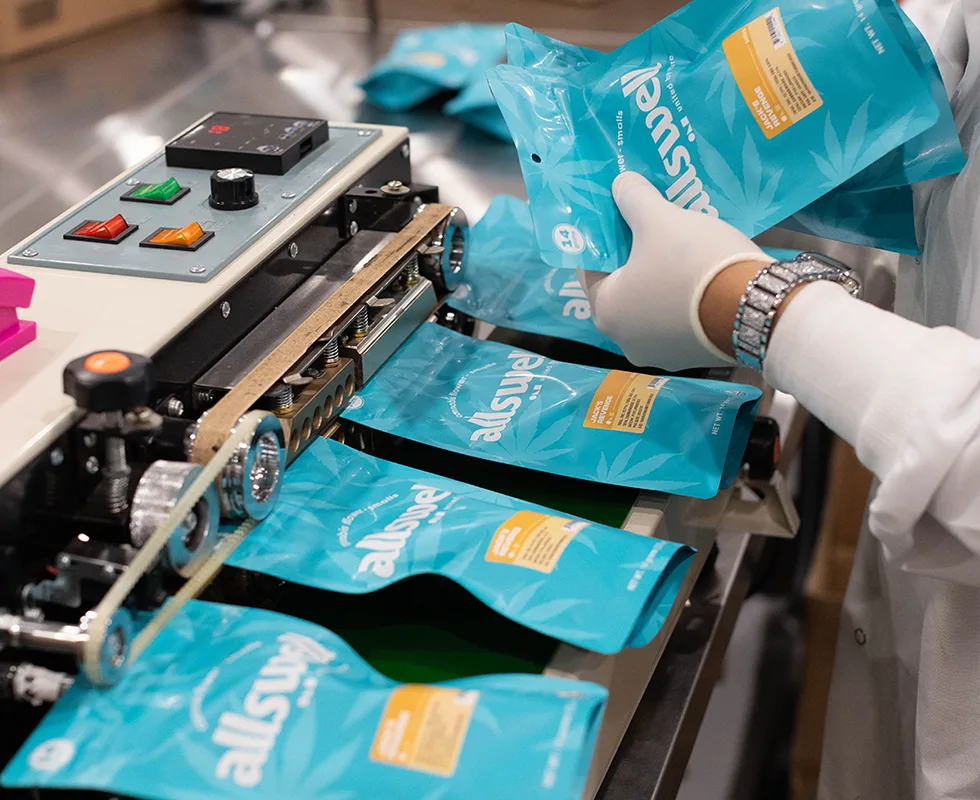
Co-packing gives the brand more control over the input supply chain. The brand sources and delivers the cannabis inputs — flower, oil, or concentrate — and the co-packer handles everything from there: packaging, labeling, compliance finishing, and Metrc.
In a co-packing arrangement:
- The brand sources and delivers bulk cannabis inputs to the facility
- The co-packer weighs, fills, packages, labels, and compliance-finishes the product
- The brand controls the input quality and supply chain
- The co-packer handles the labor-intensive production and compliance work
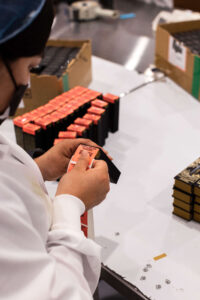
Co-packing is the faster model when the brand already has established input supply relationships. If input sourcing also needs to be built from scratch, white label is typically faster.
| Production Model | When It Is the Faster Path |
| White Label | Fastest for brands without existing cannabis supply chains — partner handles inputs and production |
| Co-Packing | Fastest for brands with existing input supply — partner handles production and compliance packaging |
The Onboarding Process: What to Expect and How Long It Takes
Onboarding with a manufacturing partner is the bridge between selecting a partner and running the first production batch. Understanding what happens during onboarding — and what the brand needs to bring to it — lets operators plan accurately and avoid delays.
What Onboarding Covers
| Onboarding Element | What It Covers |
| Product Specification Review | Fill weight targets, acceptable tolerances, product format details (cone type, hardware format, container size), infusion specifications if applicable |
| Label Artwork Compliance Review | Label artwork reviewed against current DCC requirements — primary panel, informational panel, all required elements, font sizes, universal symbol verification |
| Packaging Material Confirmation | CR packaging certification documentation reviewed, tamper seal format confirmed, all packaging components verified |
| Input Intake Protocol | How inputs will be delivered, Metrc transfer requirements for incoming inputs, intake inspection standards |
| Metrc Workflow Setup | Brand’s Metrc account relationship with the manufacturing facility established, transfer workflows confirmed |
| Quality Standards Alignment | Fill weight expectations, visual quality standards, batch documentation requirements, acceptable defect rates discussed and agreed |
| Production Scheduling | First production run scheduled, lead time confirmed, turnaround commitment agreed |
| Communication Protocol | Primary contacts on each side, update cadence during production runs, escalation process for issues |
Typical Onboarding Timeline
Onboarding with a California cannabis manufacturing partner typically takes two to four weeks from signed agreement to production-ready status.
What determines where in that range the timeline falls:
- Label artwork readiness — artwork that passes compliance review on first submission accelerates onboarding significantly; artwork that requires multiple revisions extends it
- Packaging material availability — packaging must be sourced, ordered, and delivered to the facility before production can begin; lead times on custom packaging can extend onboarding
- Input availability (co-packing) — inputs must be ready for delivery at the start of the production run; input sourcing delays extend the timeline
- Metrc account setup — brands without an existing California Metrc account will need to establish one; this process has its own timeline
- Decision speed — manufacturing partners can typically move quickly; delays most often come from the brand’s side
What Brands Can Do to Accelerate Onboarding
The fastest onboarding experiences happen when brands arrive at the manufacturing partner relationship with these elements already in progress or complete:
| Pre-Onboarding Preparation | Why It Accelerates the Timeline |
| Label Artwork in Draft | Artwork does not need to be final but should be in progress — compliance review takes time, and feedback loops add days to the timeline |
| Packaging Format Decided | CR packaging format selected and supplier identified — do not wait until after partner is selected to start this process |
| Product Specifications Documented | Fill weight targets, product format details, quality standards written down — not just in the founder’s head |
| Input Source Identified (co-packing) | For co-packing arrangements, inputs should be identified and available to deliver at the start of the first run |
| California Metrc Account Started | Metrc account setup can run in parallel with partner evaluation — do not wait until onboarding begins |
| Distribution Partner Engaged | Distribution relationship should be starting in parallel with manufacturing onboarding — not after production is complete |
The Bottlenecks That Slow Cannabis Brand Launches
Most launch delays are predictable and preventable. Understanding the common bottlenecks lets operators address them before they appear on the critical path.
Packaging Compliance Errors
This is the single most common cause of launch delays for California cannabis brands. Label artwork that fails compliance review at the manufacturing partner — or worse, at the distributor QA stage — adds days to weeks to the launch timeline.
The fix is straightforward: conduct a DCC compliance review of label artwork before submitting it to the manufacturing partner. Not a visual review — a specific check against current DCC labeling requirements. This can be done by California cannabis compliance counsel, by a knowledgeable compliance consultant, or by working with a manufacturing partner whose onboarding process includes a substantive label review.
Serial Rather Than Parallel Workstreams
Many brands approach the launch process sequentially: finish product development, then start packaging design, then find a manufacturing partner, then find a distributor, then start retail outreach.
That sequential approach adds months to the timeline unnecessarily. The fast launch playbook runs these workstreams in parallel:
| Workstream | When It Should Start |
| Manufacturing Partner Selection | Starts immediately after product concept is defined |
| Packaging Design and Compliance Review | Starts simultaneously with manufacturing partner evaluation |
| Distribution Partner Engagement | Starts while packaging design is in progress — not after production is complete |
| Retail Buyer Outreach Preparation | Pitch materials and buyer research starts while production is being set up |
| Input Sourcing | Starts in parallel with manufacturing partner onboarding |
| Metrc Account Setup | Starts as soon as licensing situation is clarified |
Waiting for the Perfect First SKU
Some brands delay launch while iterating endlessly on product specifications, packaging design, or brand identity. Perfectionism at the pre-launch stage is a real timeline killer.
The first version of a cannabis product does not need to be the final version. It needs to be compliant, high quality, and representative of the brand’s positioning. Retailers and consumers provide the most valuable feedback — and that feedback only becomes available after launch.
A good product launched on time consistently outperforms a perfect product launched three months late.
Late Distribution Engagement
Distribution is not a final step in the launch process. It is a parallel workstream that should begin at the same time as manufacturing onboarding.
Brands that wait until production is complete to engage a distribution partner add weeks to the timeline between production completion and first retail placement. The distributor’s QA review, testing coordination, and retail buyer introduction all take time — time that can be used productively while production is running if the distribution relationship is already in place.
Underestimating Testing Timeline
Laboratory testing is mandatory and takes time. Most California cannabis testing labs have turnaround times of five to fifteen business days for standard panels.
Brands that plan for their product to be available for retail the day production is complete are planning incorrectly. Testing must be completed and a passing COA must be on file with the distributor before products can be released for retail sale. Building testing time into the launch timeline — and engaging a testing lab before production begins — keeps this step from becoming a surprise delay.
| Common Bottleneck | How to Prevent It |
| Packaging Compliance Errors | Conduct compliance review before artwork goes to print — not after |
| Sequential Workstreams | Run manufacturing, packaging, distribution, and retail outreach in parallel |
| Perfectionism at Pre-Launch | Launch a good product on time rather than a perfect product late |
| Late Distribution Engagement | Start distribution partner conversations while manufacturing onboarding is happening |
| Testing Timeline Surprise | Engage a testing lab before production begins, build 5 to 15 business days into the plan |
| Metrc Account Delays | Start Metrc account setup as early as possible — do not wait until production is imminent |
| Ready to Build a Launch Plan That Actually Moves Fast?
Chronic USA® works with new brands to compress the time from concept to shelf. Talk with our team about your product, timeline, and what we can do together. |
The Fast Launch Playbook: Week-by-Week
For brands using white label or co-packing manufacturing and engaging all workstreams in parallel, here is a realistic week-by-week launch plan that targets first retail placement at week fourteen from the start.
| Timeline | Key Activities |
| Weeks 1 to 2 | Finalize product concept and specs. Begin manufacturing partner evaluation — schedule facility tours. Begin packaging design process. Identify distribution targets. Start Metrc account setup. |
| Weeks 2 to 3 | Complete manufacturing partner facility tours. Begin reference checks. Initiate packaging compliance review of draft artwork. Identify input sources (co-packing) or confirm white label input arrangement. |
| Weeks 3 to 4 | Select and sign with manufacturing partner. Begin formal onboarding. Packaging compliance review completed, revisions made if needed. Distribution partner conversations initiated. |
| Weeks 4 to 6 | Manufacturing partner onboarding — spec confirmation, label review finalization, Metrc setup, production scheduling. Packaging materials ordered and in transit. Inputs confirmed and delivery scheduled. |
| Weeks 6 to 7 | Inputs and packaging materials arrive at facility. First production run begins. Distribution partner relationship formalized. |
| Weeks 7 to 8 | First production run completes. Products transferred to distributor. Testing lab samples submitted. |
| Weeks 8 to 10 | Laboratory testing in process. Distributor QA review. Retail buyer outreach and pitch preparation. |
| Weeks 10 to 12 | Passing COA received. Products cleared for distribution. First buyer meetings conducted. |
| Weeks 12 to 14 | First retail placements confirmed. Products in transit to initial accounts. Reorder production run planning begins. |
This timeline is achievable for brands that arrive at week one with a defined product concept, a clear brand identity in progress, and the discipline to run multiple workstreams simultaneously. It compresses with a prepared brand and extends with unresolved compliance questions, packaging delays, or sequential rather than parallel execution.
What Experienced Manufacturing Partners Do to Accelerate Launch
A manufacturing partner with genuine new-brand launch experience does more than process production orders. They actively reduce the time from decision to shelf.
Proactive Compliance Review
The best manufacturing partners do not wait for brands to submit perfect label artwork. They review artwork proactively, flag compliance issues before they become problems, and provide specific guidance on what needs to change and why.
This proactive compliance support saves brands the time of discovering errors independently, engaging a compliance consultant separately, and resubmitting. It compresses the onboarding compliance review from a multi-week back-and-forth into a focused, efficient process.
Established Packaging Supplier Relationships
Packaging procurement is a common launch timeline bottleneck — especially for custom-printed packaging that has longer lead times and minimum order requirements.
Manufacturing partners with established supplier relationships can often source packaging faster than brands can independently, leverage volume pricing that individual brands cannot access, and provide guidance on which formats are available quickly versus which require extended lead times.
Distribution Connections
Some California manufacturing partners have established relationships with licensed distributors and can facilitate introductions that accelerate the distribution onboarding process.
For brands entering California without existing distributor relationships, a manufacturing partner’s ability to facilitate a warm introduction to a distribution partner — rather than starting from a cold outreach — can save two to four weeks on the distribution side of the launch timeline.
Metrc Workflow Support
California Metrc compliance is a common point of confusion for brands launching for the first time or entering California from other state markets. A manufacturing partner with established Metrc workflows and experienced compliance staff can walk new brand clients through the Metrc setup process, reducing the time and error rate of getting track-and-trace compliance in place before production.
| Ready to Launch Your Cannabis Brand in California?
Chronic USA® is a licensed Type 7 cannabis manufacturing and co-packing facility in Long Beach, California. We work with brands at every stage of launch preparation — from first conversation through first retail placement — with compliance, consistency, and speed built into every step. Our facility supports: Pre-roll manufacturing · Flower packaging · Cart filling · Concentrate packaging · White label products · Compliance packaging · Distribution support · High-volume production |
Frequently Asked Questions
What is the fastest way to launch a cannabis brand in California?
The fastest path to market for a California cannabis brand is white label or co-packing manufacturing through a licensed California manufacturing partner. This approach eliminates the 12 to 36 months required to build internal manufacturing capability (local permitting, state licensing, facility build-out, equipment, staffing) and allows brands to move from signed manufacturing partnership to first retail placement in 8 to 14 weeks when they arrive with compliant packaging artwork, defined product specifications, identified inputs, and parallel workstreams for distribution and retail outreach.
Can cannabis manufacturing be outsourced for a faster launch?
Yes. Outsourcing cannabis production to a licensed manufacturing partner is specifically what enables faster launches. The manufacturing partner’s license covers production (no manufacturing license required for the brand to start), their equipment and staff are already in place (no hiring or equipment procurement), their compliance workflows are established (no compliance system build required), and their onboarding process is designed to get new brand clients into production within weeks. White label manufacturing is the most turnkey outsourced model. Co-packing gives brands more control over input sourcing.
How long does manufacturing partner onboarding take?
Manufacturing partner onboarding typically takes two to four weeks from signed agreement to production-ready status. The timeline depends primarily on how prepared the brand is: label artwork that passes compliance review on first submission, packaging materials already sourced and available, product specifications documented, and inputs identified. Brands that arrive at the onboarding process with these elements in progress consistently complete onboarding at the faster end of the range. Brands that start these preparations after signing with a manufacturing partner add time proportionally.
What are the biggest causes of slow cannabis brand launches in California?
The most consistent causes of slow launches are packaging compliance errors that require label revisions after artwork is already in progress, running workstreams sequentially rather than in parallel, delaying distribution partner engagement until after production is complete, underestimating laboratory testing timelines (5 to 15 business days), Metrc account setup started too late, and waiting too long for a perfect product before launching. Most of these are within the brand’s control and can be addressed with preparation and parallel execution.
What is the difference between white label and co-packing for fast launches?
For brands without existing cannabis input supply chains, white label manufacturing is typically faster because the manufacturing partner handles input sourcing as well as production and packaging. For brands with established relationships for flower, oil, or concentrate, co-packing is the faster model because it removes the input sourcing step from the partner’s workflow while still outsourcing all production labor and compliance. The right choice depends on whether the brand’s input supply chain is already in place.
How can packaging compliance be handled faster during a brand launch?
Packaging compliance can be accelerated by starting the label artwork process as early as possible in the brand development timeline, conducting a DCC compliance review before artwork is submitted to the manufacturing partner (catching errors before they become production delays), working with a manufacturing partner that provides proactive compliance review as part of their onboarding process, and separating static brand elements (which can be finalized early) from batch-specific label elements like cannabinoid content (which must wait for the COA). Never finalize cannabinoid content on labels before the batch COA is received.
Does outsourcing manufacturing affect product quality for a new brand?
An experienced California manufacturing partner typically produces more consistent quality than most new brands can achieve in early-stage internal production. Their equipment is calibrated for the work, their quality control workflows are established, and their operators have production experience across the specific product category. Brands that define clear product specifications, provide consistent inputs, and maintain active communication with their manufacturing partner consistently report that outsourced production quality meets or exceeds what they could achieve internally in the early stages of building a brand.
Should distribution be engaged before or after production is complete?
Distribution should be engaged in parallel with manufacturing onboarding — not after production is complete. Brands that wait until production is finished to start distribution conversations add two to four weeks or more to the timeline between production completion and first retail placement. The distributor’s QA review, testing coordination, and retailer introduction all take time. Starting the distribution relationship while production is in process means the distributor is ready to receive products and begin QA as soon as production is complete — compressing the total launch timeline significantly.
What do experienced manufacturing partners do to help brands launch faster?
Manufacturing partners with new-brand launch experience contribute to faster launches through proactive compliance review that catches label issues before they become production delays, established packaging supplier relationships that provide faster sourcing at better pricing, distribution connections that facilitate warm introductions to distribution partners, and Metrc workflow support that reduces the time and error rate of getting California track-and-trace compliance in place. The combination of these contributions from an experienced partner can compress the launch timeline by four to six weeks compared to a brand managing all of these elements independently.
